In a non-isosceles acute triangle , is the midpoint of the edge . The points and lie on and , respectively, and the circumcircles of and intersect at on . The angle bisector of in triangle intersects the line at . Prove that the tangent line to the circumcircle of at is perpendicular to .
Turkey — Team Selection Test
Solution
Since , , , are cyclic, we have .
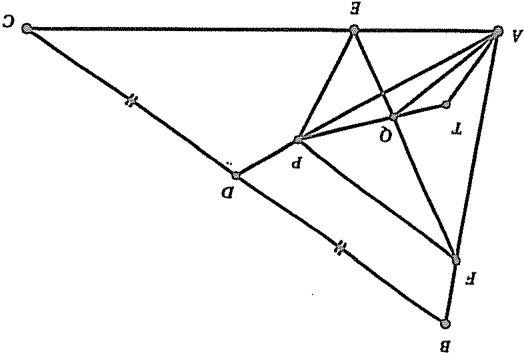
As , , , are cyclic, we also get . Therefore, we have and hence, , , , are cyclic as well.
Since , , , are cyclic, we have . Similarly, we have . Since , , , are cyclic. Thus, as we obtain .
On the other hand, since is an angle bisector, we get . and therefore, which implies that is the angle bisector of in triangle .
Let be the intersection of and the line perpendicular to passing through . Since is an altitude and is angle bisector in triangle , we have . By angle chasing we have and . As is an angle bisector in , we get and hence, we obtain which implies that is tangent to the circumcircle of and we are done.
Want a route through all this instead of an archive? The track
puts 2,604 problems in a working order, from Junior Challenge level to the IMO shortlist.