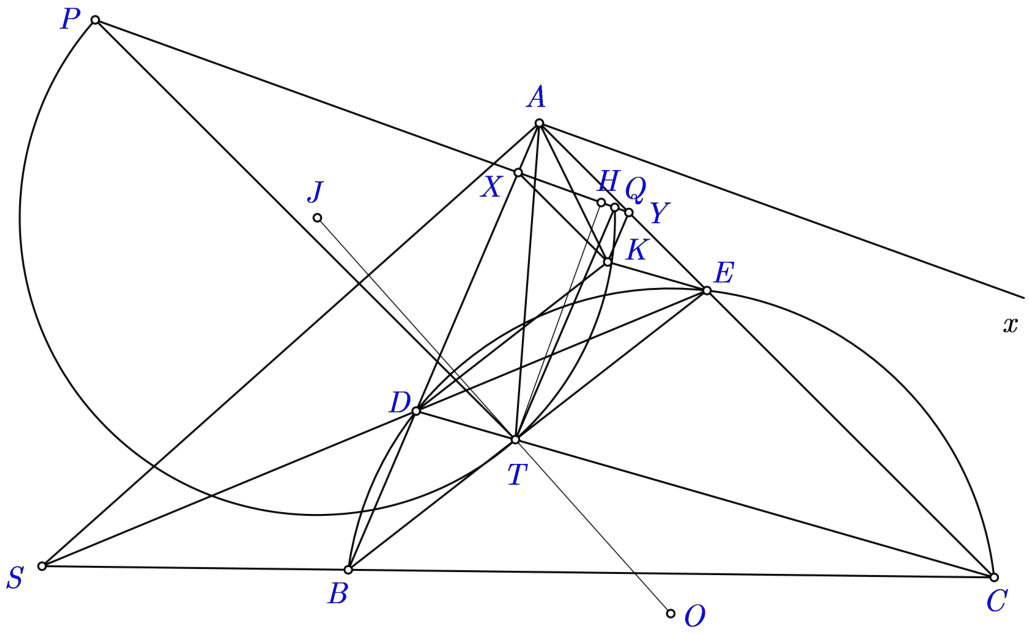
Let be an isosceles acute triangle with is the bisector of angle . A circle with center passes through and intersects the sides at respectively. Construct a parallelogram . Take on respectively such that is also a parallelogram. Construct on such that and . Prove that passes through the center of the circumcircle of triangle .
SAUDI ARABIAN IMO Booklet, 2023
Solution
Since is cyclic, we have two similar triangles and . On the other hand
Thus two points are corresponding in the above pair of similar triangles, it can be deduced that
implies that are symmetric through .
Lemma: if two rays are isogonal in angle then every pair of isogonal lines in angle are also isogonal in angle . We will use this idea to solve the problem. Let be the center of and be the projection of onto . Then, according to the symmetry of the altitude and the line joining the center, we immediately have isogonal in . On the other hand,
so lines are isogonal in angle and then are also isogonal in . To prove three points are collinear, we will show that lines are isogonal in .
Denote as the intersection of , then by applying Brocard's theorem to the completed quadrilateral we have . Draw then . Notice that is a parallelogram, so passes through the midpoint of , leads to
Furthermore, so consider the symmetry over the line , we have , and take . Then
so or is symmetric about . Through , draw lines perpendicular to , then two sets of four lines
are perpendicular respectively. This implies that are isogonal in . Finally, since , we have are also isogonal in and deduce to is true.
Want a route through all this instead of an archive? The track
puts 2,604 problems in a working order, from Junior Challenge level to the IMO shortlist.