Let be a triangle △ABC with m(∠ABC)=75∘ and m(∠ACB)=45∘. The angle bisector of ∠CAB intersects CB at the point D. We consider the point E∈(AB), such that DE=DC. Let P be the intersection of the lines AD and CE. Prove that P is the midpoint of the segment AD.
Solutions — 2
Solution 1
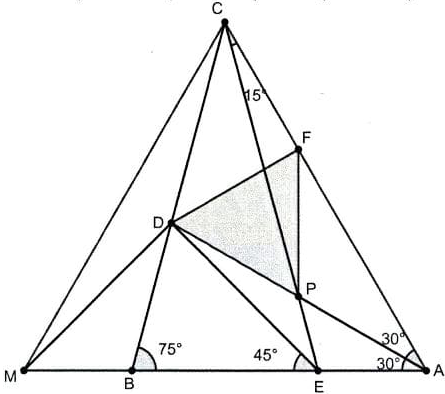
Let P′ be the midpoint of the segment AD. We will prove that P′=P. Let F∈AC such that DF⊥AC. The triangle CDF is isosceles with FD=FC and the triangle DP′F is equilateral as m(∠ADF)=60∘. Thus, the triangle FCP′ is isosceles (FP′=FC) and m(∠FCP′)=m(∠FP′C)=15∘.
Figure 2: G2
We prove now that m(∠FCE)=15∘. Let M be the point on [AB such that the triangle ACM is equilateral. As △ADC≡△ADM(SAS)⇒DC=DM(=DE) and m(∠AMD)=m(∠ACD)=45∘. It follows that the triangle △DME is isosceles with m(∠DME)=m(∠DEM)=45∘. In the triangle △BDE we have m(∠BDE)=60∘ and thus m(∠CDE)=120∘. As the triangle DCE is isoscel with m(∠DCE)=m(∠DEC)=30∘. Finally m(∠ACE)=m(∠ACB)−m(∠BCE)=45∘−30∘=15∘. Thus m(∠FCP′)=15∘=m(∠FCE), and therefore P′∈CE and P′=P, which means that P is the midpoint of the segment AD.
Solution 2
In the way as above we prove that m(∠BCE)=15∘. So the quadrilateral ACDE is inscribed in a circle. Now, applying the sine rules to △DPE and △APE we get sin30∘DPAPDP=sin15∘PE,=sin105∘⋅sin15∘sin30∘sin105∘AP=4⋅sin105∘⋅sin15∘1=sin30∘PE=2⋅(cos90∘−cos120∘)1=2⋅211=1.⇒sin30∘DP⋅APsin105∘=sin15∘PE⋅PEsin30∘, Thus, QP=AP. □
Want a route through all this instead of an archive? The track
puts 2,604 problems in a working order, from Junior Challenge level to the IMO shortlist.
Source: MathNet,
licensed CC-BY-4.0.
Statement reproduced verbatim; metadata (topic, difficulty) added by this project.