Given a convex -gon in the plane. For every three vertices of , consider the triangle determined by them. Call such a triangle good if all its sides are of unit length.
Prove that there are not more than good triangles.
IMO Shortlist, 2007
Solution
Consider all good triangles containing a certain vertex . The other two vertices of any such triangle lie on the circle with unit radius and center . Since is convex, all these vertices lie on an arc of angle less than . Let be the shortest such arc, oriented clockwise (see Figure 1). Each of segments and belongs to a unique good triangle. We say that the good triangle with side is assigned counterclockwise to , and the second one, with side , is assigned clockwise to . In those cases when there is a single good triangle containing vertex , this triangle is assigned to twice.
There are at most two assignments to each vertex of the polygon. (Vertices which do not belong to any good triangle have no assignment.) So the number of assignments is at most .
Consider an arbitrary good triangle , with vertices arranged clockwise. We prove that is assigned to its vertices at least three times. Then, denoting the number of good triangles by , we obtain that the number of all assignments is at most , while it is not less than . Then , as required.
Actually, we prove that triangle is assigned either counterclockwise to or clockwise to . Then, by the cyclic symmetry of the vertices, we obtain that triangle is assigned either counterclockwise to or clockwise to , and either counterclockwise to or clockwise to , providing the claim.
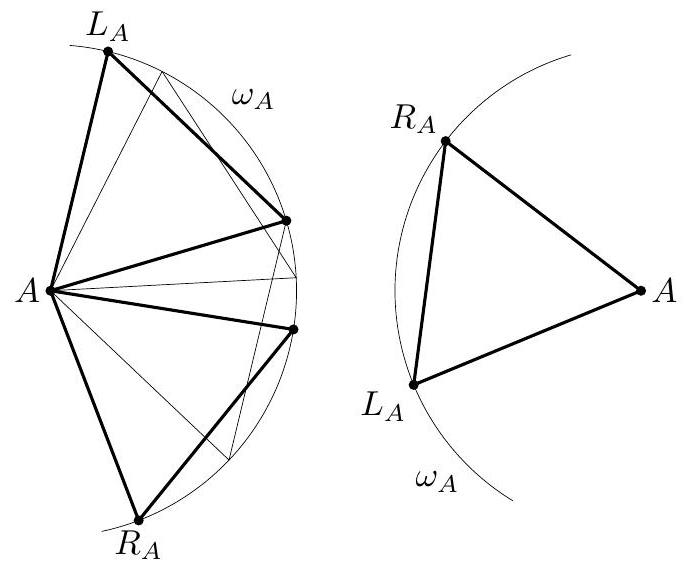
Figure 1
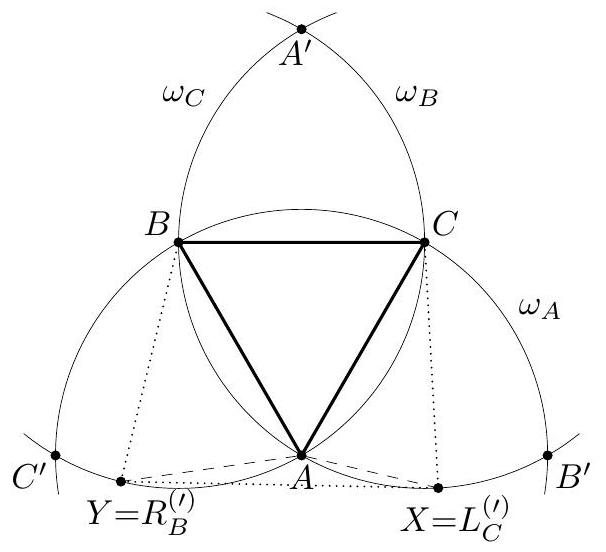
Figure 2
Assume, to the contrary, that and . Denote by , , the intersection points of circles , and , distinct from (see Figure 2). Let be the good triangle containing . Observe that the angle of is less than . Then one of the points and belongs to arc of ; let this point be . In the case when and , choose .
Analogously, considering the good triangle which contains as an edge, we see that one of the points and lies on arc of . Denote this point by , . Then angles , , and (oriented clockwise) are not greater than . Hence, point lies in quadrilateral (either in its interior or on segment ). This is impossible, since all these five points are vertices of .
Hence, each good triangle has at least three assignments, and the statement is proved.
Want a route through all this instead of an archive? The track
puts 2,604 problems in a working order, from Junior Challenge level to the IMO shortlist.