Maths Olympiad Prep

Library / /9 of 24

, 2019

Geometry Difficulty 8.3 Shortlist Prove it Balkan Mathematical Olympiad

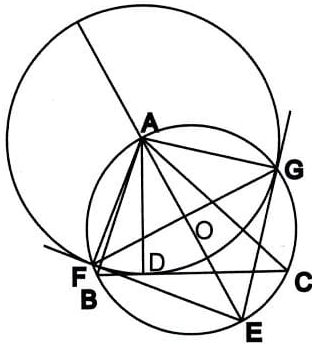
Let ABCABC be a scalene and acute triangle, with circumcentre OO. Let ω\omega be the circle with centre AA, tangent to BCBC at DD. Suppose there are two points FF and GG on ω\omega such that FGAOFG \perp AO, BFD=DGC\angle BFD = \angle DGC and the couples of points (B,F)(B, F) and (C,G)(C, G) are in different halfplanes with respect to the line ADAD. Show that the tangents to ω\omega at FF and GG meet on the circumcircle of ABCABC.

Solutions — 2

Solution 1

Consider any two points F,GF, G on ω\omega such that BFD=DGC\angle BFD = \angle DGC. Exploiting the isosceles triangles AFG\triangle AFG, AFD\triangle AFD, and ADG\triangle ADG, we deduce (using directed angles throughout):
DBFGCD=180BFDBDF(180DGCCDG)=CDGFDB=12(DAGDAF)=12[(1802ADG)(1802ADF)]=ADFGDA=DFAAGD=DFGFGD=BFGFGC, \angle DBF - \angle GCD = 180^\circ - \angle BFD - \angle BDF - (180^\circ - \angle DGC - \angle CDG) \stackrel{*}{=} \\ \angle CDG - \angle FDB = \frac{1}{2} \cdot (\angle DAG - \angle DAF) = \frac{1}{2} \cdot [(180^\circ - 2 \angle ADG) - (180^\circ - 2 \angle ADF)] = \\ \angle ADF - \angle GDA = \angle DFA - \angle AGD = \angle DFG - \angle FGD \stackrel{*}{=} \angle BFG - \angle FGC,
where we use BFD=DGC\angle BFD = \angle DGC at ()(*). Thus BFGCBFGC is cyclic.

Figure 1
Figure 3: G3

Now, if in addition FGAOFG \perp AO, then since AA is the centre of ω\omega, in fact AOAO is the perpendicular bisector of FGFG. But by definition, since ABCABC is scalene, AOAO meets the perpendicular bisector of BCBC at OO. Hence OO is the centre of BFGCBFGC, and thus in fact BFAGCBFAGC is cyclic. But then the lines perpendicular to AFAF at FF, and AGAG at GG (the tangents to ω\omega) must intersect at EE, the point antipodal to AA on BFAGC\odot BFAGC. \square

Solution 2

Let the circumcircle of ABCABC be Γ\Gamma. From the conditions, GG is the reflection of FF in the line AOAO. Let B,DB', D' be the reflections of B,DB, D across this same line AOAO. Clearly DD' also lies on ω\omega and BB' lies on Γ\Gamma.
Then, using directed angles, CGD=DFB=BGD\angle CGD = \angle DFB = \angle B'GD' so
BGC=BGDCGD=CGDCGD=DGD=12DAD=OAD. \angle B'GC = \angle B'GD' - \angle CGD' = \angle CGD - \angle CGD' = \angle D'GD = \frac{1}{2}\angle D'AD = \angle OAD.

Then, exploiting the isogonality property that DAB=CAO\angle DAB = \angle CAO, we have
OAD=CAB2DAB=ABCBCA=ABCBBA=BBC. \angle OAD = \angle CAB - 2\angle DAB = \angle ABC - \angle BCA = \angle ABC - \angle B'BA = \angle B'BC.
So GG lies on Γ\Gamma, and by the reflection property so does FF.
But then, as in the previous solution, the tangents at FF and GG to ω\omega must intersect at EE, the point antipodal to AA on Γ\Gamma. \square

Want a route through all this instead of an archive? The track puts 2,000 problems in a working order, from AMC 10 level to the IMO shortlist.

Source: MathNet, licensed CC-BY-4.0. Statement and solution reproduced as published; topic and difficulty added by this site.