Given a circle and its chord which is not the diameter. Let be any point inside the longer arc of . We denote by and the reflections of and with respect to the axes and . Prove that the distance of the midpoints of the line segments and is independent of the location of the point .
Cesko-Slovacko-Poljsko
Solutions — 2
Solution 1
Denote by the midpoint of , by the midpoint of , and by and the feet of the altitudes from and in the triangle . Obviously, and are the midpoints of and respectively (fig. 3). Therefore is the mid-segment in the triangle and is the mid-segment in the triangle . We have
thus is a parallelogram (this is true even in the case of "degenerate" triangles or ).
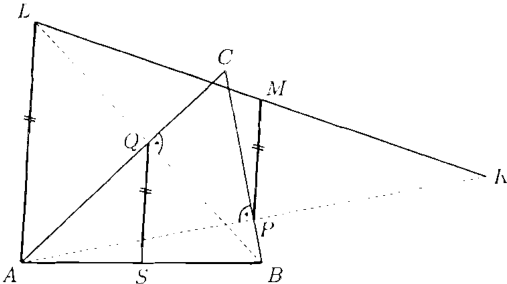
Fig. 3
The points and lie on the Thales circle over , so . This implies the parallelogram is a rhombus and the length of its side is independent of the location of . To prove that also the length of its diagonal is independent of , it suffices to show that the size of the angle spanned by its sides and is constant when moving along (then all the rhombuses and also their diagonals are congruent).
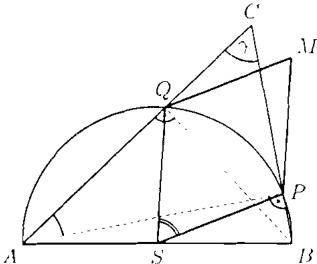
Fig. 4a
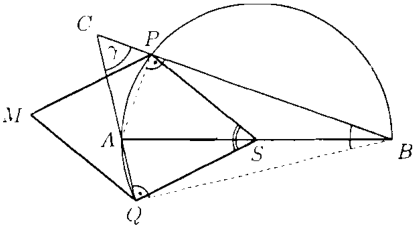
Fig. 4b
If the angle in the triangle is acute, the point lies inside of (the angle is always acute by the statement of the problem) and the angle is central to the angle , which is inscribed over the chord of the Thales circle over (fig. 4a). Hence
The same formula we get when is non-acute, since in this case is acute and we can use the inscribed angle instead of (fig. 4b):
As the size of does not change when moving along (it is an inscribed angle over the fixed chord ), the size of the angle also does not change.
Solution 2
Denote by the angles of the triangle . We only consider the case ; the second case () is similar. Let be the midpoints of the segments respectively. Let be the common point of the lines and (fig. 5a, b). Note that the quadrilateral is a parallelogram () and
By the law of sines applied to the triangle ,
so the triangles and are proportional (two sides proportional and the same angle between them). Then again by the law of sines.
which obviously does not depend of the location of the point .
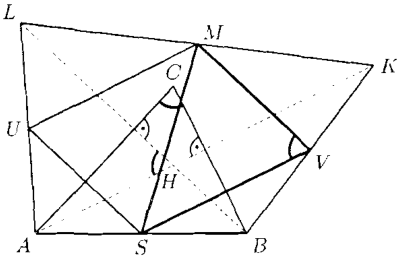
Fig. 5a
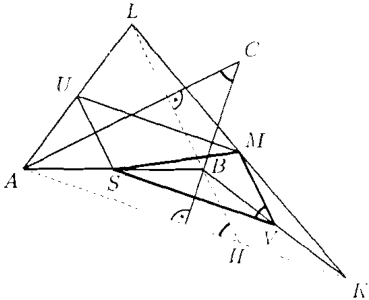
Fig. 5b
Want a route through all this instead of an archive? The track
puts 2,604 problems in a working order, from Junior Challenge level to the IMO shortlist.