Maths Olympiad Prep

Library / /4 of 23

Geometry Difficulty 7.7 National olympiad, round 2 Prove it United States

Let PP be a point in the plane of triangle ABCABC such that the segments PAPA, PBPB, and PCPC are the sides of an obtuse triangle. Assume that in this triangle the obtuse angle opposes the side congruent to PAPA. Prove that BAC\angle BAC is acute.

Solutions — 6

Solution 1

By the Cauchy-Schwarz Inequality,
PB2+PC2AC2+AB2PBAC+PCAB. \sqrt{PB^2 + PC^2} \sqrt{AC^2 + AB^2} \ge PB \cdot AC + PC \cdot AB.
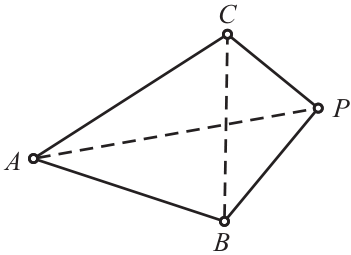
Applying the (Generalized) Ptolemy's Inequality to quadrilateral ABPCABPC yields
PBAC+PCABPABC. PB \cdot AC + PC \cdot AB \geq PA \cdot BC.
Figure 1
Because PAPA is the longest side of an obtuse triangle with side lengths PAPA, PBPB, PCPC, we have PA>PB2+PC2PA > \sqrt{PB^2 + PC^2} and hence
PABCPB2+PC2BC. PA \cdot BC \geq \sqrt{PB^2 + PC^2} \cdot BC.
Combining these three inequalities yields AB2+AC2>BC\sqrt{AB^2 + AC^2} > BC, implying that angle BACBAC is acute.

Solution 2

Let DD and QQ be the feet of the perpendiculars from BB and PP to line ACAC, respectively. Then DQBPDQ \leq BP. Furthermore, the given conditions imply that AP2>BP2+PC2AP^2 > BP^2 + PC^2, which can be written as AP2PC2>BP2AP^2 - PC^2 > BP^2. Hence,
AQ2AQ2QC2=(AP2PQ2)(CP2PQ2)=AP2PC2>BP2DQ2. \begin{align*} AQ^2 &\geq AQ^2 - QC^2 \\ &= (AP^2 - PQ^2) - (CP^2 - PQ^2) \\ &= AP^2 - PC^2 \\ &> BP^2 \\ &\geq DQ^2. \end{align*}
Let \ell be the ray ACAC minus the point AA. Note that, since PA>PCPA > PC, QQ lies on ray \ell. If DD did not lie on \ell, then AQAQ would be less than or equal to DQDQ, a contradiction. Thus, DD lies on \ell, and angle BACBAC is acute.

Solution 3

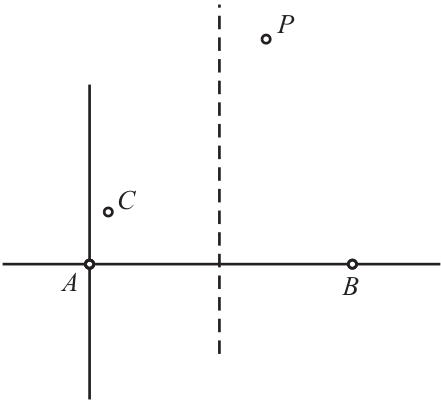
Figure 2
Set up a coordinate system on the plane with A=(0,0)A = (0,0), B=(a,0)B = (a,0), C=(b,c)C = (b,c), and P=(x,y)P = (x,y). Without loss of generality, we may assume that a>0a > 0 and that c>0c > 0. Proving that angle BACBAC is acute is equivalent to proving that b>0b > 0. Since PA2>PB2+PC2PA^2 > PB^2 + PC^2,
x2+y2>(xa)2+y2+(xb)2+(yc)2. x^2 + y^2 > (x-a)^2 + y^2 + (x-b)^2 + (y-c)^2.
Hence,
0>(xa)22bx+b2+(yc)22bx. 0 > (x-a)^2 - 2bx + b^2 + (y-c)^2 \geq -2bx.
Since PA>PBPA > PB, we have x>a2>0x > \frac{a}{2} > 0. It follows that b>0b > 0, as desired.

Solution 4

We first prove the following Lemma.

Lemma. For any four points WW, XX, YY, and ZZ in the plane,
WY2+XZ2WX2+XY2+YZ2+ZW2. WY^2 + XZ^2 \leq WX^2 + XY^2 + YZ^2 + ZW^2.
Proof. Pick an arbitrary origin OO and let ww, xx, yy, zz denote the vectors from OO to WW, XX, YY, ZZ, respectively. Then
WX2+XY2+YZ2+ZW2WY2XZ2=wx2+xy2+yz2+zw2wy2xz2=ww+xx+yy+zz2(wx+xy+yz+zwwyxz)=w+yxz2, \begin{align*} WX^2 + XY^2 + YZ^2 + ZW^2 - WY^2 - XZ^2 \\ &= |w-x|^2 + |x-y|^2 + |y-z|^2 + |z-w|^2 - |w-y|^2 - |x-z|^2 \\ &= w \cdot w + x \cdot x + y \cdot y + z \cdot z \\ &\quad -2(w \cdot x + x \cdot y + y \cdot z + z \cdot w - w \cdot y - x \cdot z) \\ &= |w+y-x-z|^2, \end{align*}
which is always nonnegative. Equality holds if and only if w+y=x+zw + y = x + z, which is true if and only if WXYZWXYZ is a (possibly degenerate) parallelogram.

Applying the Lemma to points AA, BB, CC, and PP gives
0AB2+BP2+PC2+CA2AP2BC2=(PB2+PC2PA2)+(AB2+AC2BC2)<0+(AB2+AC2BC2)=AB2+AC2BC2. \begin{align*} 0 \le AB^2 + BP^2 + PC^2 + CA^2 - AP^2 - BC^2 \\ &= (PB^2 + PC^2 - PA^2) + (AB^2 + AC^2 - BC^2) \\ &< 0 + (AB^2 + AC^2 - BC^2) \\ &= AB^2 + AC^2 - BC^2. \end{align*}
Therefore, angle BACBAC is acute.

Solution 5

In this solution, sin1\sin^{-1} takes on values between 00^\circ and 9090^\circ. Note that PAB<90\angle PAB < 90^\circ, since PB<PAPB < PA. Applying the Law of Sines to triangle PABPAB yields
sinPAB=PBPAsinABPPBPA. \sin \angle PAB = \frac{PB}{PA} \sin \angle ABP \le \frac{PB}{PA}.
It follows that
PABsin1PBPA. \angle PAB \le \sin^{-1} \frac{PB}{PA}.
Since PA2>PB2+PC2PA^2 > PB^2 + PC^2, we have similarly
PACsin1PCPA<sin1PA2PB2PA. \angle PAC \le \sin^{-1} \frac{PC}{PA} < \sin^{-1} \frac{\sqrt{PA^2 - PB^2}}{PA}.
Thus,
BACBAP+PAC<sin1PBPA+sin1PA2PB2PA. \begin{align*} \angle BAC &\le \angle BAP + \angle PAC \\ &< \sin^{-1} \frac{PB}{PA} + \sin^{-1} \frac{\sqrt{PA^2 - PB^2}}{PA}. \end{align*}
If θ=sin1PBPA\theta = \sin^{-1} \frac{PB}{PA}, then sin(90θ)=cosθ=1sin2θ=PA2PB2PA\sin(90^\circ - \theta) = \cos \theta = \sqrt{1 - \sin^2 \theta} = \frac{\sqrt{PA^2 - PB^2}}{PA}.
Hence,
BAC<sin1PBPA+sin1PA2PB2PA=90, \angle BAC < \sin^{-1} \frac{PB}{PA} + \sin^{-1} \frac{\sqrt{PA^2 - PB^2}}{PA} = 90^\circ,
and angle BACBAC is acute.

Solution 6

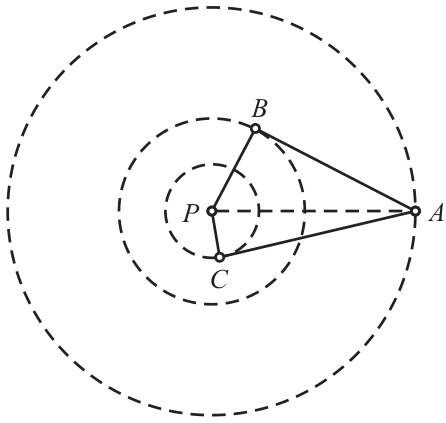
Figure 3
Note that PA2>PB2+PC2PA^2 > PB^2 + PC^2. Regard PP as fixed and A,BA, B, and CC as free to rotate on circles of radii PA,PBPA, PB, and PCPC about PP, respectively. As A,B,CA, B, C vary, BAC\angle BAC will be maximized when BB and CC are on opposite sides of line PAPA and ABP\angle ABP and ACP\angle ACP are right angles, i.e., lines ABAB and ACAC are tangent to the circles passing through BB and CC.
Without loss of generality, we assume that PA>PBPCPA > PB \ge PC. In this case, ABPCABPC is cyclic and AB2=PA2PB2>PC2AB^2 = PA^2 - PB^2 > PC^2, and similarly AC2>PB2AC^2 > PB^2. Hence, on the circumcircle of ABPCABPC, arcs ABAB and ACAC are bigger than arcs PCPC and PBPB, respectively. Thus, BPC>BAC\angle BPC > \angle BAC. Since these two angles are supplementary, angle BACBAC is acute.

Want a route through all this instead of an archive? The track puts 2,000 problems in a working order, from AMC 10 level to the IMO shortlist.

Source: MathNet, licensed CC-BY-4.0. Statement and solution reproduced as published; topic and difficulty added by this site.