Points , , , lie on a line in this order. Draw parallel lines and through and , respectively, and parallel lines and through and , respectively, such that their points of intersection are vertices of a square. Prove that the side length of this square does not depend on the length of segment .
Saudi Arabian Mathematical Competitions
Solutions — 2
Solution 1
Denote by the side length of the square and construct , , where , . Let be the angle defined by lines and .
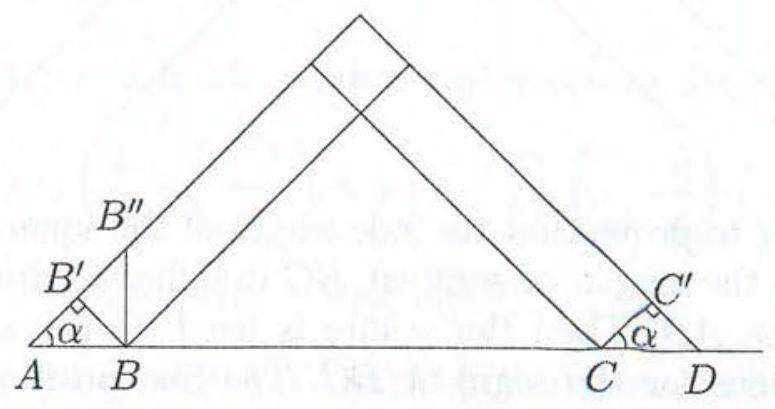
In triangle we have , and in triangle we have . It follows
hence
and the conclusion follows.
Remark. We have and this formula shows how we can construct the lines , , , through points , , , in order to get the square. Let and . Then construct the line and . Finally, construct and .
Solution 2
(Saleh Saeed Al-Gamdi and Abrar Abdulmanem Al-Shaikh).
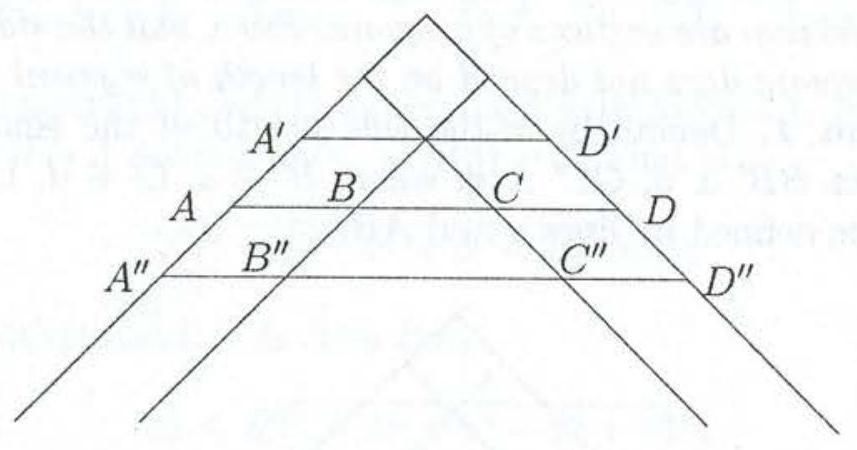
In order to prove that the side length of the square does not depend on the length of segment it suffices to draw parallel lines to line . Then the square is fixed; we get all possible configurations for the segment . The first position is , where points , coincide with one vertex of the square.
Want a route through all this instead of an archive? The track
puts 2,604 problems in a working order, from Junior Challenge level to the IMO shortlist.