The inscribed circle of triangle , with centre , touches sides , and at , and , respectively. Let be a point, on the same side of as , for which and . Prove that , and lie on a straight line.
South African Mathematics Olympiad Third Round
Solution
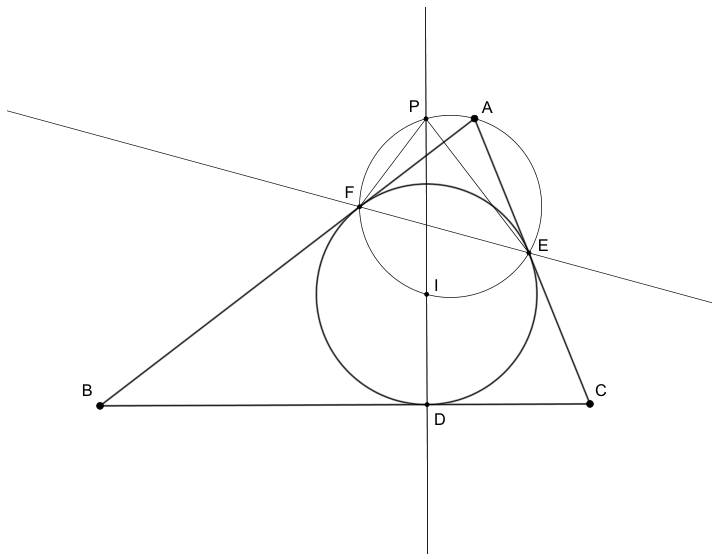
Since , the points , , , lie on a circle with diameter . Moreover, since and by our assumptions on , triangles and are similar, so . was assumed to lie on the same side of as , thus it follows that also lies on the same circle as , , and .
We also know that is a cyclic quadrilateral (using the same reasoning as before, namely that ), so .
Now we can conclude that , so , which means that , , lie on a straight line.
Want a route through all this instead of an archive? The track
puts 2,604 problems in a working order, from Junior Challenge level to the IMO shortlist.