Maths Olympiad Prep

Library / /37 of 106

Geometry Difficulty 8.2 Shortlist Prove it China

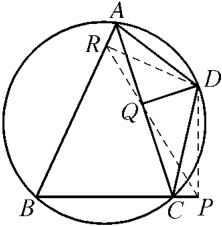
Let ABCDABCD be an inscribed quadrilateral. Let PP, QQ and RR be the feet of the perpendiculars from DD to the lines BCBC, CACA and ABAB respectively. Show that PQ=QRPQ = QR if and only if the bisectors of ABC\angle ABC and ADC\angle ADC meet on ACAC.

Solution

Proof By Simson's Theorem, we know that PP, QQ, RR are collinear. Moreover, since DPC\angle DPC and DQC\angle DQC are right angles, the points DD, PP, QQ, CC are concyclic and so DCA=DPQ=DPR\angle DCA = \angle DPQ = \angle DPR. Similarly, since DD, QQ, RR, AA are concyclic, we have DAC=DRP\angle DAC = \angle DRP. Therefore DCADPR\triangle DCA \sim \triangle DPR.

Figure 1

Likewise, DABDQP\triangle DAB \sim \triangle DQP and DBCDRQ\triangle DBC \sim \triangle DRQ. Then
DADC=DRDP=DBQRBCDBPQBA=QRPQBABC. \frac{DA}{DC} = \frac{DR}{DP} = \frac{DB \cdot \frac{QR}{BC}}{DB \cdot \frac{PQ}{BA}} = \frac{QR}{PQ} \cdot \frac{BA}{BC}.
Thus PQ=QRPQ = QR if and only if DADC=BABC\frac{DA}{DC} = \frac{BA}{BC}.

Now the bisectors of the angles ABCABC and ADCADC divide ACAC in the ratios of BABC\frac{BA}{BC} and DADC\frac{DA}{DC} respectively. This completes the proof.

Want a route through all this instead of an archive? The track puts 2,000 problems in a working order, from AMC 10 level to the IMO shortlist.

Source: MathNet, licensed CC-BY-4.0. Statement and solution reproduced as published; topic and difficulty added by this site.