Let be an equilateral triangle. Let be a point on the side and be a point on the side so that both triangles and are acute. Let be the orthocentre of triangle and be the orthocentre of triangle . Let be the point common to the segments and . Find all possible values of and such that triangle is equilateral.
APMO
Solution
We are going to show that this can only happen when
Lemma. If , then .
Proof. Let , and be the altitudes of triangle concurrent at its centre . Then lies on , lies on , and thus lies in triangle .
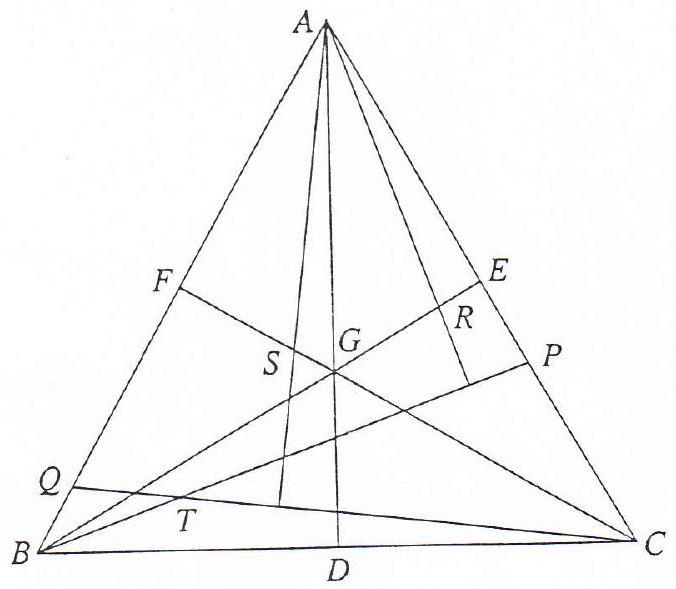
Note that -
Since , we have so that
Let be the projection of onto and be the projection of onto , and similarly for and . We have
and
It follows that .
[1 mark for stating the Lemma, 3 marks for proving it.]
Thus, if is equilateral, we must have .
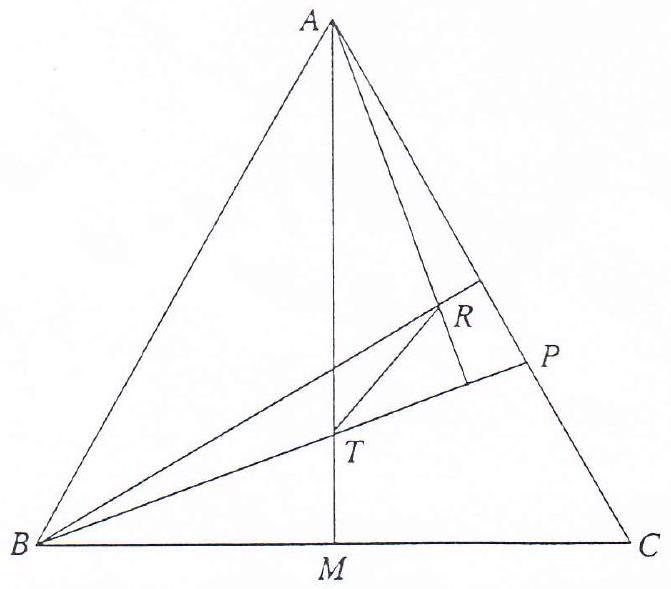
It is clear from the symmetry of the figure that , so is equilateral if and only if . Now, as is an altitude of the triangle , . So is equilateral if and only if is a cyclic quadrilateral. Therefore, is equilateral if and only if . But
and so
But these angles must be equal, so . Therefore .
[3 marks for finishing the proof with the assumption that .]
Want a route through all this instead of an archive? The track
puts 2,604 problems in a working order, from Junior Challenge level to the IMO shortlist.