a) It is well known that KE, KF are both tangent to (I). Thus, GK is the symmedian of ∠GEF, it follows that LE = HF. Hence, AH, AL are isogonal with respect to angle BAC. It is clear that AH is the diameter of (I). Therefore AL is the altitude of ∠AEF.
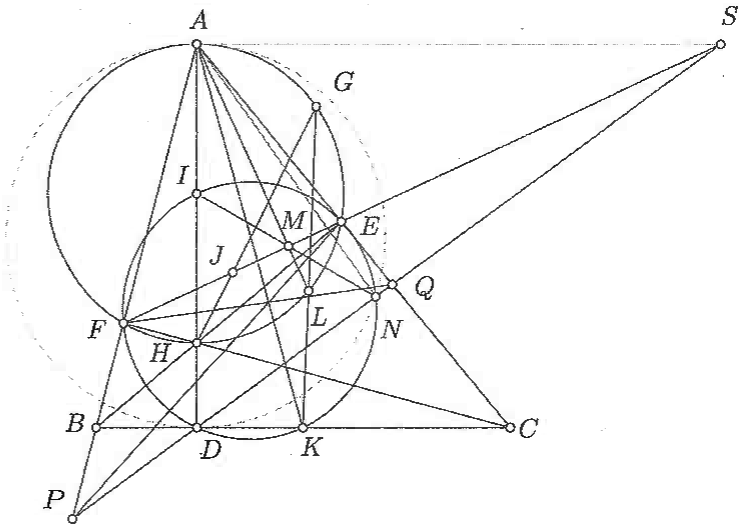
b) Since I is the midpoint of AH, it's clear that (IEF) is the Euler's circle of ∠ABC with the diameter IK. Besides,
MI⋅MN=ME⋅MF=MA⋅ML,
this implies that A, I, L and N are concyclic. Therefore,
∠ANI=∠ALI=∠LAI=∠DIK,
since IK∥AL (both lines are perpendicular to EF). Hence,
∠AND=∠ANI+∠IND=∠DIK+∠IKD=90∘.
Let S be the radical center of (I), (IEF) and (ADN). Since EF is the radical axis of (I) and (IEF) then EF passes through S. Similarly, DN passes through S. Since the centers of (AND), I and A are collinear, we have (AND) and (I) are tangent at A, thus AS is tangent to (I), in other words, AS∥BC. Hence, A(SK,QP)=A(SK,CB)=−1, it follows that PE, QF and AK are concurrent. □