The triangle ABC is acute-angled, so the points D, E and F lie on the sides BC, CA and AB, respectively. Since ∣AB∣>∣AC∣, we have ∣BD∣>∣CD∣.
Furthermore, from ∠ACB<∠ABC it follows that C lies between B and P. Also, C lies between A and Q, while R lies on the segment BF.
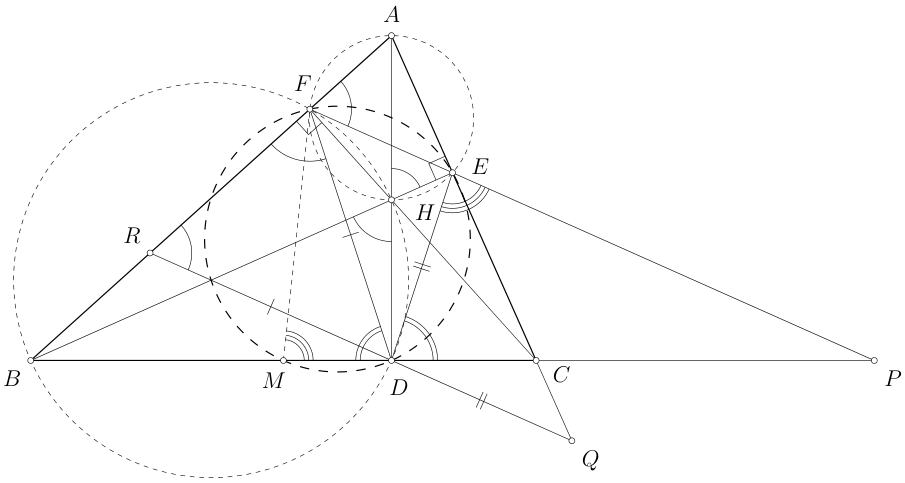
Let H be the orthocentre of the triangle ABC, and let M be the midpoint of its side BC. The lines DR and EF are parallel, hence ∠DRF=∠EFA. The quadrilateral AFHE is cyclic (∠AFH=∠AEH=90∘), so we have ∠EFA=∠EHA. The quadrilateral BDHF is cyclic as well (∠BDH=∠BFH=90∘), hence ∠EHA=∠DHB=∠DFB=∠DFR. Now from ∠DRF=∠DFR it follows that ∣DR∣=∣DF∣.
Similarly, the lines DQ and FE are parallel, hence ∠DQE=∠FEA. The quadrilateral AFHE is cyclic, so we have ∠FEA=∠FHA. The quadrilateral CEHD is cyclic as well (∠CEH=∠CDH=90∘), hence ∠FHA=∠DHC=∠DEC=∠DEQ. Now from ∠DQE=∠DEQ it follows that ∣DQ∣=∣DE∣.
The points M, F, E and D lie on the same circle (called the nine-point circle or the Feuerbach's circle), hence ∠FMD=180∘−∠FED=∠PED. Also, ∠FDH=∠FBH=∠ABE=90∘−∠CAB=∠ACF=∠ECH=∠EDH.
Therefore, ∠FDM=90∘−∠FDH=90∘−∠EDH=∠PDE, so the triangles FDM and PDE are similar. Now we conclude that
∣DM∣∣DF∣=∣DE∣∣DP∣,
from which it follows that ∣DF∣⋅∣DE∣=∣DP∣⋅∣DM∣, i.e.
∣DR∣⋅∣DQ∣=∣DP∣⋅∣DM∣,
meaning that the quadrilateral PQMR is cyclic.
Let k be its circumscribed circle. Since ∠NQP+∠NRP<180∘, N lies inside the circle k, i.e. on the segment CM, and N=M holds. Since M is the midpoint of the segment BC, we finally get ∣BN∣>∣CN∣.