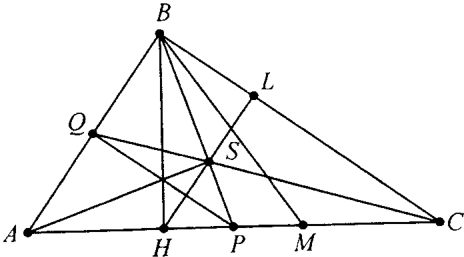
In the acute-angled triangle ABP (AB>BP) the altitudes are BH, PQ and AS. The extension of QS intersects line AP at C. The extension of HS intersects BC at L. If HS=SL and HL is perpendicular to BC, compute SCSL.
Solution
Since SH=SL, we compute the ratio SCSH. Note that AB>BP implies that P is between A and C. Denote ∠BAP=α and observe that ∠PSC=∠PSH=∠BSL=∠BSQ=α. Indeed we have ∠HSB=∠QSP=180∘−α from the cyclic quadrilaterals AHSB and APSQ. On the other hand each of the four angles in the above equality completes ∠HSB or ∠QSP to 180∘. In particular ∠PSC=∠PSH means that SP is the internal bisector of ∠CSH. Since AS⊥SP, it follows that SA is the external bisector of ∠CSH. Hence SCSH=ACAH by the external angle theorem.
To find ACAH consider the midpoint M of HC. The right triangles BHL and BCH are similar as they share an acute angle at vertex B. Since BS and BM are respective medians, ∠BMH=∠BSL. We proved above that ∠BSL=α, hence ∠BMH=α=∠BAH. Therefore triangle ABM is isosceles with base AM. Its altitude BH is also a median, so AH=HM. In addition HM=MC, and we obtain AH=31AC. In conclusion SCSL=SCSH=ACAH=31.
Want a route through all this instead of an archive? The track
puts 2,604 problems in a working order, from Junior Challenge level to the IMO shortlist.
Source: MathNet,
licensed CC-BY-4.0.
Statement reproduced verbatim; metadata (topic, difficulty) added by this project.