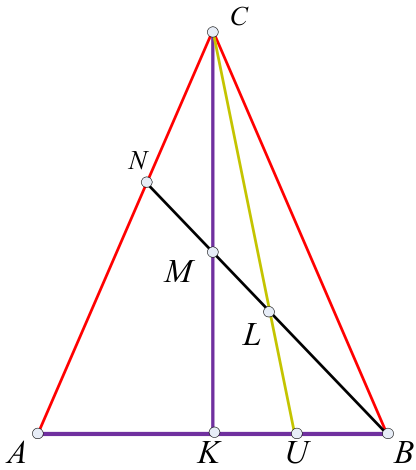
A segment AB and its midpoint K are given. An arbitrary point C, different from K, is chosen on the perpendicular to AB through K. Let N be the intersection of AC and the line passing through B and the midpoint of the segment CK. Let U be the intersection of AB with the line that passes through C and the midpoint L of the segment BN. Prove that the ratio of the areas of the triangles CNL and BUL doesn't depend on the choice of point C.
A segment AB and its midpoint K are given. An arbitrary point C, different from K, is chosen on the perpendicular to AB through K. Let N be the intersection of AC and the line passing through B and the midpoint of the segment CK. Let U be the intersection of AB with the line that passes through C and the midpoint L of the segment BN. Prove that the ratio of the areas of the triangles CNL and BUL doesn't depend on the choice of point C.
Solution
Let M be the midpoint of the segment CK. From Menelaus' theorem for the triangle AKC and the line BN we have NACN⋅BKAB⋅MCKM=1. From this we get NA=2NC, from which it follows that AC=3NC. Hence PBNC=31PABC. From Menelaus' theorem for the triangle ABN and the line CU we have UBAU⋅LNBL⋅CANC=1. Therefore we get AU=3UB. Therefore U is the midpoint of the segment BK. It follows that PBUC=41PABC. Let x=PCNL and y=PBLU. Since L is the midpoint of BN, we have PBLC=x. Now x+y=PBLC+PBLU=PBUC=41PABC, on the other hand we have 2x=PCNL+PBLC=PBNC=31PABC. If we divide these two equalities we get 21+2xy=43, hence xy=21, from where we get the required statement.
Want a route through all this instead of an archive? The track
puts 2,604 problems in a working order, from Junior Challenge level to the IMO shortlist.
Source: MathNet,
licensed CC-BY-4.0.
Statement reproduced verbatim; metadata (topic, difficulty) added by this project.