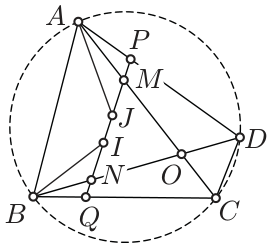
Let ABCD be a cyclic quadrangle, let the diagonals AC and BD cross at O, and let I and J be the incentres of the triangles ABC and ABD, respectively. The line IJ crosses the segments OA and OB at M and N, respectively. Prove that the triangle OMN is isosceles.
Solution
We show that ∠OMN≡∠ONM. To this end, let the line IJ cross the segments AD and BC at P and Q, respectively, and consider the position of J relative to the line AC, to write ∠ OMN ≡∠ AJP ±∠ JAM ≡∠ AJP ±(∠ JAD ∓∠ CAD) ≡∠ AJP + ∠ JAD - ∠ CAD ≡∠ AJP + ∠ BAJ - ∠ CAD. Similarly, ∠ONM≡∠BIQ+∠ABI−∠CBD. Since the quadrangle ABCD is cyclic, ∠CAD≡∠CBD and ∠ACB≡∠ADB. The latter implies that ∠AIB≡∠AJB, so the quadrangle ABIJ is cyclic. Consequently, ∠AJP≡∠ABI and ∠BAJ≡∠BIQ, and the conclusion follows.
Want a route through all this instead of an archive? The track
puts 2,000 problems in a working order, from AMC 10 level to the IMO shortlist.
Source: MathNet,
licensed CC-BY-4.0.
Statement and solution reproduced as published; topic and difficulty added by this site.