Let H be the orthocenter of △ABC, lines AA1 and BC intersect at point A3. Then △A3BA1∼△ABA3, △A1A3C∼△ACA3⇒CA32=A3A1⋅AA3=BA32⇒CA3=BA3 (fig. 6).
Since ∠BA1C=180∘−∠BAC, by means of the triangles BB0A and CC0A we can easily find that ∠BHC=180∘−∠BAC, i.e. ∠BA1C=∠BHC. Therefore,
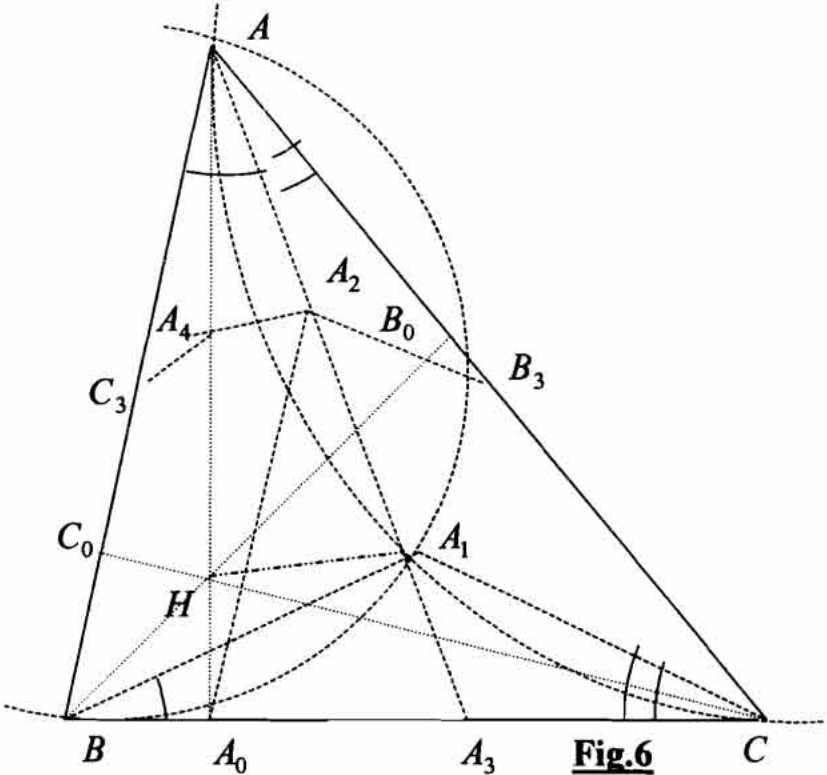
Fig. 6
B,H,A1,C are circular points and ∠HA1C=180∘−∠HBC=90∘+γ. Since ∠A3A1C=∠A1AC+∠A1CA=γ⇒∠HA1A3=∠HA1C−∠A3A1C=90∘−γ+γ=90∘=∠HA1A. Hence A,C0,H,A1 are circular points. Therefore, ∠AA1C0=∠AHC0=180∘−∠AHC=180∘−A0HC0=β since points B,C0,H,A1 are also circular. Therefore, △AA1C0∼△ABA3.
If we find point C3=CC1∩AB similarly to the previous constructions, it will be a midpoint of the side AB. Therefore, C3 and A2 are midpoints of the respective sides of the similar triangles. Thus, ∠C0A2A1=∠A3C3B=α. But ∠C0A0A3=90∘+∠AA0C0=90∘+∠C0BH=180∘−α and therefore A0,C0,A2,A3 are circular points. This implies that point A2 belongs to the circle of nine points of △ABC. Similarly points B2 and C2 also belong to this circle.
Then we obtain that ∠C0A1A2=β, ∠C0A2A1=α, therefore △A1A2C0∼△ABC⇒ACC0A2=ABA2A1. Similarly ABB0A2=ACA2A1⇒B0A2C0A2=AB2AC2=sin∠B0A0A2sin∠C0A0A2 since all the points A0,B0,C0, and A2 are on one circle. Similarly A0C2B0C2=AC2BC2=sin∠A0C0C2sin∠B0C0C2 and C0B2A0B2=CB2AB2=sin∠C0B0B2sin∠A0B0B2.
Let's multiply the last equalities sin∠B0A0A2sin∠C0A0A2⋅sin∠A0C0C2sin∠B0C0C2⋅sin∠C0B0B2sin∠A0B0B2=1. The Ceva theorem implies that lines A0A2, B0B2, and C0C2 intersect at one point.