Maths Olympiad Prep

Library / /11 of 106

Geometry Difficulty 7.7 National olympiad, round 2 Prove it IMO

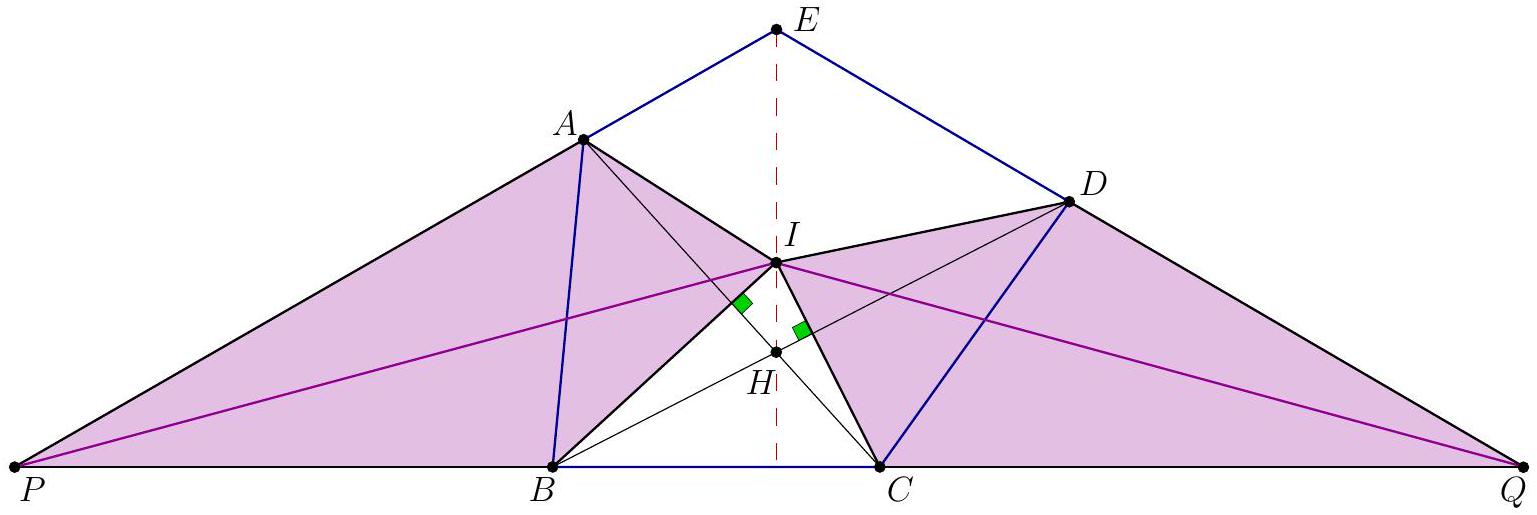
Let ABCDEA B C D E be a convex pentagon such that AB=BC=CDA B = B C = C D, EAB=BCD\angle E A B = \angle B C D, and EDC=CBA\angle E D C = \angle C B A. Prove that the perpendicular line from EE to BCB C and the line segments ACA C and BDB D are concurrent.

Solutions — 3

Solution 1

Throughout the solution, we refer to A,B,C,D\angle A, \angle B, \angle C, \angle D, and E\angle E as internal angles of the pentagon ABCDEA B C D E. Let the perpendicular bisectors of ACA C and BDB D, which pass respectively through BB and CC, meet at point II. Then BDCIB D \perp C I and, similarly, ACBIA C \perp B I. Hence ACA C and BDB D meet at the orthocenter HH of the triangle BICB I C, and IHBCI H \perp B C. It remains to prove that EE lies on the line IHI H or, equivalently, EIBCE I \perp B C.

Lines IBI B and ICI C bisect B\angle B and C\angle C, respectively. Since IA=IC,IB=IDI A = I C, I B = I D, and AB=BC=CDA B = B C = C D, the triangles IAB,ICBI A B, I C B and ICDI C D are congruent. Hence IAB=ICB=C/2=A/2\angle I A B = \angle I C B = \angle C / 2 = \angle A / 2, so the line IAI A bisects A\angle A. Similarly, the line IDI D bisects D\angle D. Finally, the line IEI E bisects E\angle E because II lies on all the other four internal bisectors of the angles of the pentagon.

The sum of the internal angles in a pentagon is 540540^{\circ}, so
E=5402A+2B. \angle E = 540^{\circ} - 2 \angle A + 2 \angle B .
In quadrilateral ABIEA B I E,
BIE=360EABABIAEI=360A12B12E=360A12B(270AB)=90+12B=90+IBC, \begin{aligned} \angle B I E & = 360^{\circ} - \angle E A B - \angle A B I - \angle A E I = 360^{\circ} - \angle A - \frac{1}{2} \angle B - \frac{1}{2} \angle E \\ & = 360^{\circ} - \angle A - \frac{1}{2} \angle B - \left(270^{\circ} - \angle A - \angle B\right) \\ & = 90^{\circ} + \frac{1}{2} \angle B = 90^{\circ} + \angle I B C, \end{aligned}
which means that EIBCE I \perp B C, completing the proof.

Solution 2

We present another proof of the fact that EE lies on line IHI H. Since all five internal bisectors of ABCDEA B C D E meet at II, this pentagon has an inscribed circle with center II. Let this circle touch side BCB C at TT.

Applying Brianchon's theorem to the (degenerate) hexagon ABTCDEA B T C D E we conclude that AC,BDA C, B D and ETE T are concurrent, so point EE also lies on line IHTI H T, completing the proof.

Solution 3

We present yet another proof that EIBCE I \perp B C. In pentagon ABCDEA B C D E, E<180A+B+C+D>360\angle E < 180^{\circ} \Longleftrightarrow \angle A + \angle B + \angle C + \angle D > 360^{\circ}. Then A+B=C+D>180\angle A + \angle B = \angle C + \angle D > 180^{\circ}, so rays EAE A and CBC B meet at a point PP, and rays BCB C and EDE D meet at a point QQ. Now,
PBA=180B=180D=QDC \angle P B A = 180^{\circ} - \angle B = 180^{\circ} - \angle D = \angle Q D C
and, similarly, PAB=QCD\angle P A B = \angle Q C D. Since AB=CDA B = C D, the triangles PABP A B and QCDQ C D are congruent with the same orientation. Moreover, PQEP Q E is isosceles with EP=EQE P = E Q.

Figure 1

In Solution 1 we have proved that triangles IABI A B and ICDI C D are also congruent with the same orientation. Then we conclude that quadrilaterals PBIAP B I A and QDICQ D I C are congruent, which implies IP=IQI P = I Q. Then EIE I is the perpendicular bisector of PQP Q and, therefore, EIPQEIBCE I \perp P Q \Longleftrightarrow E I \perp B C.

Want a route through all this instead of an archive? The track puts 2,000 problems in a working order, from AMC 10 level to the IMO shortlist.

Source: MathNet, licensed CC-BY-4.0. Statement and solution reproduced as published; topic and difficulty added by this site.