Maths Olympiad Prep

Library / /8 of 39

, 2012

Geometry Difficulty 5.1 AIME, harder Prove it Belarus

Determine the greatest possible value of the area of a quadrilateral ABCDABCD if the length of broken line ABDCABDC is equal to LL.

Solution

Answer: S(ABCD)=L2/8S(ABCD) = L^2/8.
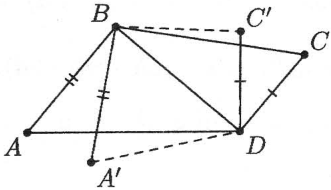
Let the area of ABCDABCD be a maximum for some AB=xAB = x, BD=yBD = y, CD=zCD = z, x+y+z=Lx + y + z = L. Since S(ABCD)=S(ABD)+S(DBC)=12ABBDsinABD+12BDDCsinBDCS(ABCD) = S(ABD) + S(DBC) = \frac{1}{2} AB \cdot BD \sin \angle ABD + \frac{1}{2} BD \cdot DC \sin \angle BDC, we see that the area of the quadrilateral with fixed values of xx, yy, zz is maximum if ABD=CDB=90\angle ABD = \angle CDB = 90^\circ. Therefore,
S(ABCD)=12xy+12yz=12y(x+z)==[x+y+z=Lx+z=Ly]=12y(Ly). \begin{aligned} S(ABCD) &= \frac{1}{2}xy + \frac{1}{2}yz = \frac{1}{2}y(x+z) = \\ &= [x+y+z = L \Rightarrow x+z = L-y] = \frac{1}{2}y(L-y). \end{aligned}

Figure 1

It is easy to see that for 0<y<L0 < y < L the value of the product y(Ly)y(L-y) is a maximum if y=L/2y = L/2 and it is equal to L2/4L^2/4. Therefore, the maximal value of ABCDABCD with given sum of its sides ABAB, CDCD and diagonal BDBD, AB+BD+DC=LAB + BD + DC = L, is equal to L2/8L^2/8.

Want a route through all this instead of an archive? The track puts 2,000 problems in a working order, from AMC 10 level to the IMO shortlist.

Source: MathNet, licensed CC-BY-4.0. Statement and solution reproduced as published; topic and difficulty added by this site.