Maths Olympiad Prep

Library / /4 of 28

Geometry Difficulty 8.0 Shortlist Prove it China

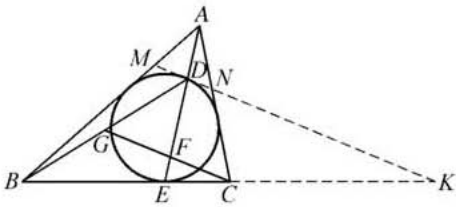
In triangle ABCABC, we have AB>ACAB > AC. The incircle ω\omega touches BCBC at EE, and AEAE intersects ω\omega at DD. Choose a point FF on AEAE (FF is different from EE), such that CE=CFCE = CF. Let GG be the intersection point of CFCF and BDBD. Prove that CF=FGCF = FG.

Solution

Proof Referring to the figure, draw a line from DD, tangent to ω\omega, and the line intersects ABAB, ACAC, BCBC at points MM, NN, KK respectively.
Figure 1
Since
KDE=AEK=EFC, \angle KDE = \angle AEK = \angle EFC,
we know MKCGMK \parallel CG.
By Newton's theorem, the lines BNBN, CMCM, DEDE are concurrent.
By Ceva's theorem, we have
BEECCNNAAMMB=1.1 \frac{BE}{EC} \cdot \frac{CN}{NA} \cdot \frac{AM}{MB} = 1. \qquad \textcircled{1}
From Menelaus' theorem,
BKKCCNNAAMMB=1.2 \frac{BK}{KC} \cdot \frac{CN}{NA} \cdot \frac{AM}{MB} = 1. \qquad \textcircled{2}
① ÷ ②, we have
BEKC=ECBK, BE \cdot KC = EC \cdot BK,
thus
BCKE=2EBCK.3 BC \cdot KE = 2EB \cdot CK. \qquad \textcircled{3}
Using Menelaus' theorem and ③, we get
1=CBBEEDDFFGGC=CBBEEKCKFGGC=2FGGC. 1 = \frac{CB}{BE} \cdot \frac{ED}{DF} \cdot \frac{FG}{GC} = \frac{CB}{BE} \cdot \frac{EK}{CK} \cdot \frac{FG}{GC} = \frac{2FG}{GC}.
So CF=GFCF = GF.

Want a route through all this instead of an archive? The track puts 2,000 problems in a working order, from AMC 10 level to the IMO shortlist.

Source: MathNet, licensed CC-BY-4.0. Statement and solution reproduced as published; topic and difficulty added by this site.