Is it possible to assign numbers to the vertices of a cube in a way that the assigned number of each vertex divides the sum of numbers assigned to its neighbours? (Note that every number should be used once).
Iranian Mathematical Olympiad
Solution
The answer is no. First, for every we define to be the set of numbers assigned to the vertices adjacent to the vertex with number . By the problem's assumption, the sum of elements of is divisible by . Since the sum of every three numbers less than is at most , the sum of elements of is either or . By checking different cases, it is easy to see equals to either , , , or . We will check these different cases.
* If , let . Evidently . Now, by assumption, , and . These imply and so . This contradicts .
* The case is similar to the previous case. We only need to consider instead of .
* If , denote by the numbers of other vertices as in the figure below. We have . It follows from that is a divisor of so . On the other hand, . Therefore must be either , which is impossible.
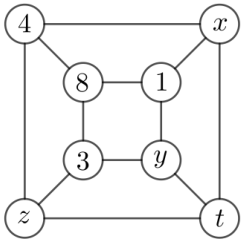
* If , denote the numbers of other vertices by as in the figure below. In this case . By a similar argument to the previous case, we have . On the other hand, , so is a divisor of , again impossible.
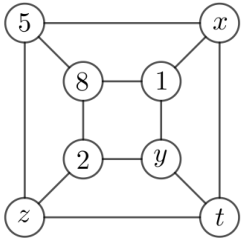
Therefore, in each case, the numbers cannot be assigned to the vertices of the cube and the solution is complete. ■
Want a route through all this instead of an archive? The track
puts 2,604 problems in a working order, from Junior Challenge level to the IMO shortlist.