Points , , and lie on a circle with centre . The reflection of point in the line lies inside triangle and is the intersection of the angular bisectors of angles and . (The angular bisector of an angle is the line that divides the angle into two equal angles.) Line intersects the circle again in point .
Show that .
Final Round, September, 2019
Solution
Let be the reflection of point in the line . We define and . Since is the angular bisector of , we find that . Since is the reflection of in the line , we find that . Triangle is isosceles with apex , because . Hence, we see that . In the same way, we see that and . The sum of the angles of triangle is therefore . From this, we conclude that , and hence that .
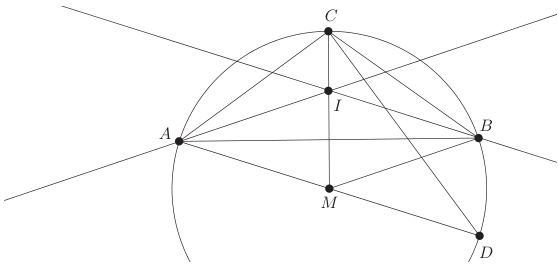
Since is an isosceles triangle (as ), we see that . It follows from this that and therefore that triangle is isosceles. By considering the sum of the angles in triangle , we find that . Hence we also find that . We have already seen that . It follows that triangles and are both isosceles triangles with an angle of at the apex. Hence, they are similar triangles. This implies that . By multiplying by both denominators and observing that , we obtain the required result.
Want a route through all this instead of an archive? The track
puts 2,604 problems in a working order, from Junior Challenge level to the IMO shortlist.