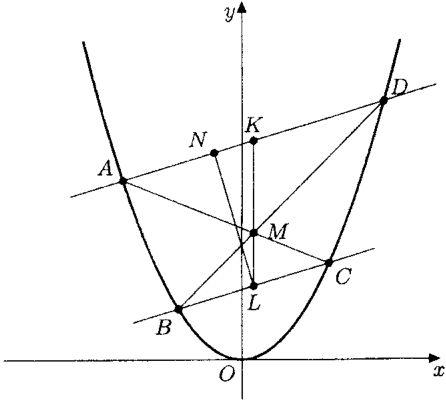
Four points A, B, C, D are marked on the parabola y=x2 so that the quadrilateral ABCD is a trapezoid (AD∥BC, AD>BC). Let m and n be the distances between the intersection point of the diagonals of the trapezoid and the midpoints of its bases AD and BC, respectively. Find the area of ABCD. (D. Bazylev, I. Voronovich)
Solution
Answer: S=m−n(m+n)2.
Let xR,yR denote the coordinates of point R. Let y=kx+a and y=kx+b be the equations of the lines AD and BC, respectively. Then {xA2=yA=kxA+a,xD2=yD=kxD+a,{xB2=yB=kxB+b,xC2=yC=kxC+b. So,
k=xA+xD=xB+xC,(1) a=−xAxD,b=−xBxC.(2) Since K and L are the midpoints of the sides AD and BC respectively, we see that xK=0.5(xA+xD),xL=0.5(xB+xC).(3) It is well-known fact that point M of intersection of the diagonals of the trapezoid ABCD lies on the segment joining the midpoints of the trapezoid bases. Taking into account (3) we see that the segment KL containing M is perpendicular to the axis Ox, and xM=xK=xL. Let α be the angle between the lines AD, BC and the positive direction of Ox, then tanα=k. If LN is an altitude of the trapezoid ABCD, then ∠NLK=α (LN⊥AD,KL⊥Ox). Therefore LN=KLcosα. On the other hand, AD=(yD−yA)/cosα, BC=(yC−yB)/cosα. Therefore, the required area is equal to S=21(AD+BC)LN=21(yD−yA+yC−yB)KL⋅sinαcosα=[KL=m+n]==21(yD−yA+yC−yB)⋅km+n=21(kyD−yA+kyC−yB)(m+n)=(1)=21(xD−xA+xC−xB)(m+n)(4) Let y=k1x+c be the equation of the line BD. Then {xB2=yB=k1xB+c,xD2=yD=k1xD+c,⇒k1=xB+xD,c=−xBxD.(5) So, yM=0.5k1(xA+xD)+c=0.5k1(xB+xC)+c. Therefore, from (1) - (3), and (5) it follows that m=yK−yM=21(xA+xD)(xA+xD)−xAxD−21(xB+xD)(xA+xD)+xBxD==21(xA+xD)(xA−xB)−xD(xA−xB)=21(xA−xB)(xA−xD). n=yM−yL=(1)21(xB+xD)(xA+xD)−xBxD−21(xA+xD)(xA+xD)+xBxC==21(xA+xD)(xB−xA)−xB(xD−xC)=[xD−xC=(1)xB−xA]==21(xB−xA)(xA+xD−2xB)=(1)21(xB−xA)(xC−xB). Then m+n=21(xB−xA)(xC−xB+xD−xA). Hence, (4) can be presented in the form S=21⋅xB−xA2(m+n)(m+n)=xB−xA(m+n)2. Note that m−n=21(xB−xA)(xD−xA−xC+xB)=[xD−xC=(1)xB−xA]=(xB−xA)2.
Therefore, finally, we have S=xB−xA(m+n)2=m−n(m+n)2.
Want a route through all this instead of an archive? The track
puts 2,604 problems in a working order, from Junior Challenge level to the IMO shortlist.
Source: MathNet,
licensed CC-BY-4.0.
Statement reproduced verbatim; metadata (topic, difficulty) added by this project.