Maths Olympiad Prep

Library / /110 of 120

, 2012

Geometry Difficulty 6.4 National olympiad Prove it Saudi Arabia

Let ABCABC be a triangle, IaI_a the excenter opposite to AA, and MM its reflection across BCBC. Prove that AMAM is parallel to the Euler line of triangle BCIaBCI_a.

Solutions — 2

Solution 1

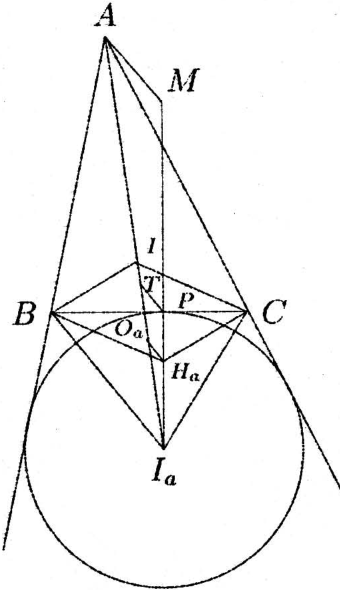
Let II be the incenter of ABCABC, HaH_a the orthocenter of IaBCI_aBC, and OaO_a the midpoint of the segment IIaII_a.

Figure 1

We have
BOa=IOa=IaOa=COa, BO_a = IO_a = I_aO_a = CO_a,
so OaO_a is the circumcenter of triangle IaBCI_aBC.

Moreover, IBCHaIB \parallel CH_a (both are perpendicular to BIaBI_a) and, similarly, ICBHaIC \parallel BH_a, hence BICHaBICH_a is a parallelogram.

Let PP denote the projection of IaI_a onto BCBC and TT the midpoint of segment AIaAI_a. We have HaP=rH_aP = r, hence
IAAIa=rra=HaPIaP. \frac{IA}{AI_a} = \frac{r}{r_a} = \frac{H_aP}{I_aP}.
Therefore
HaIaIaP=IIaIaA=2IaOa2IaT=IaOaIaT.(1) \frac{H_a I_a}{I_a P} = \frac{I I_a}{I_a A} = \frac{2 I_a O_a}{2 I_a T} = \frac{I_a O_a}{I_a T}. \quad (1)
The relation (1) proves that OaHaO_a H_a is parallel to TPTP. But TPAMTP \parallel AM, hence AMOaHaAM \parallel O_a H_a, and we are done.

Solution 2

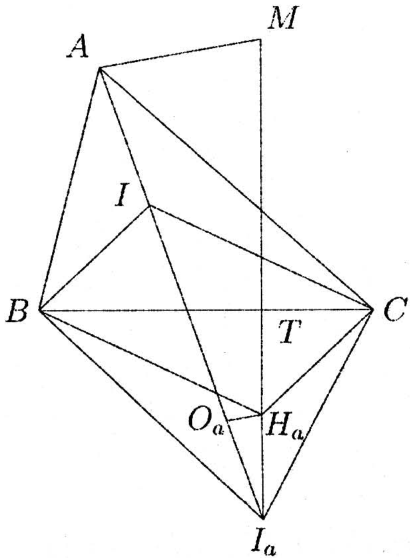
We will use the notation in the previous solution. The quadrilateral BICIaBICI_a is cyclic, inscribed in a circle of diameter IIaII_a, which implies OaO_a is the midpoint of segment IIaII_a. Also, we have that IBHaCIBH_aC is a parallelogram.

Figure 2

We want to prove that
IaOaIaA=IaHaIaM.(1) \frac{I_a O_a}{I_a A} = \frac{I_a H_a}{I_a M}. \qquad (1)
We have
IAIIa=K[BIA]K[BIIa]=csinB2BIa. \frac{IA}{II_a} = \frac{K[BIA]}{K[BII_a]} = \frac{c \sin \frac{B}{2}}{BI_a}.
Hence
AOaOaIa=IA+12IIa12IIa=csinB2+12BIa12BIa=1+csinB212BIa,(2) \frac{AO_a}{O_a I_a} = \frac{IA + \frac{1}{2}II_a}{\frac{1}{2}II_a} = \frac{c \sin \frac{B}{2} + \frac{1}{2}BI_a}{\frac{1}{2}BI_a} = 1 + \frac{c \sin \frac{B}{2}}{\frac{1}{2}BI_a}, \quad (2)
and
THaHaIa=TCsinB2CIasinA2. \frac{TH_a}{H_a I_a} = \frac{TC \sin \frac{B}{2}}{CI_a \sin \frac{A}{2}}.
The relation (3) implies
MHaHaIa=1+2TCsinB2CIasinA2.(4) \frac{MH_a}{H_a I_a} = 1 + \frac{2TC \sin \frac{B}{2}}{CI_a \sin \frac{A}{2}}. \qquad (4)
We have
csinB2BIa=TCsinB2CIasinA2csinA2TC=BIaCIa=sin(90C2)sin(90B2) \frac{c \sin \frac{B}{2}}{BI_a} = \frac{TC \sin \frac{B}{2}}{CI_a \sin \frac{A}{2}} \Leftrightarrow \frac{c \sin \frac{A}{2}}{TC} = \frac{BI_a}{CI_a} = \frac{\sin\left(90^\circ - \frac{C}{2}\right)}{\sin\left(90^\circ - \frac{B}{2}\right)} \Leftrightarrow
csinA2sb=cosC2cosB2c(sb)(sc)bcsb=s(sc)abs(sb)ac \frac{c \sin \frac{A}{2}}{s-b} = \frac{\cos \frac{C}{2}}{\cos \frac{B}{2}} \Leftrightarrow \frac{c \sqrt{\frac{(s-b)(s-c)}{bc}}}{s-b} = \frac{\sqrt{\frac{s(s-c)}{ab}}}{\sqrt{\frac{s(s-b)}{ac}}} \Leftrightarrow
csb=csb, \frac{\sqrt{c}}{\sqrt{s-b}} = \frac{\sqrt{c}}{\sqrt{s-b}},
a relation which is obviously true. It follows that
AOaOaIa=MHaHaIa, \frac{AO_a}{O_a I_a} = \frac{MH_a}{H_a I_a},
and therefore AMOaHaAM \parallel O_aH_a.

Want a route through all this instead of an archive? The track puts 2,000 problems in a working order, from AMC 10 level to the IMO shortlist.

Source: MathNet, licensed CC-BY-4.0. Statement and solution reproduced as published; topic and difficulty added by this site.