The orthocenter and the circumcenter of a non-equilateral triangle ABC are H and O, respectively. Let D be the foot of the altitude dropped from the vertex A of the triangle ABC. Prove that ∠AHO=90∘ if and only if HDAH=2.
Solutions — 2
Solution 1
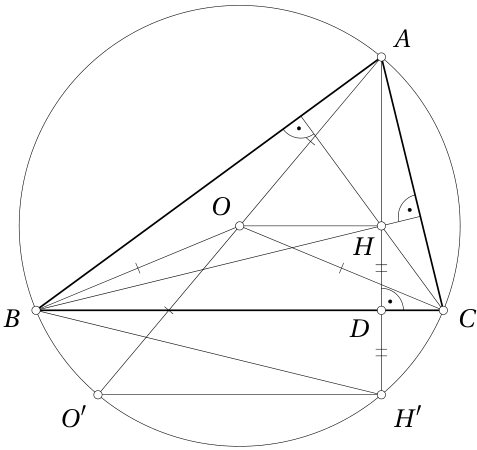
Let O′ be the other endpoint of the diameter of the circumcircle of the triangle ABC drawn from the vertex A and let H′ be the reflection of the point H through the line BC (Fig. 35). Then HD=H′D, whence the condition HDAH=2 is equivalent to the condition AH′AH=21=AO′AO. Thus HDAH=2 if and only if OH∥O′H′.
It is known that H′ lies on the circumcircle of the triangle ABC. Thus by Thales' theorem, ∠AH′O′=90∘. Hence the condition OH∥O′H′ is equivalent to the condition ∠AHO=90∘. Consequently, HDAH=2 if and only if ∠AHO=90∘.
Solution 2
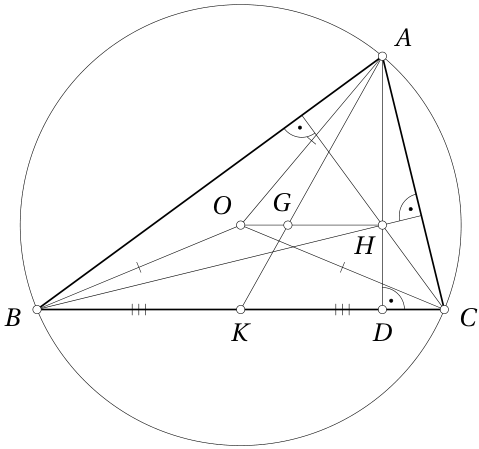
W.l.o.g., assume AC≤AB. Let G be the centroid of the triangle ABC and K be the midpoint of the side BC (Fig. 36). Then GKAG=2. Thus HDAH=2 if and only if HDAH=GKAG, which in turn is valid if and only if HG∥DK. The latter condition is equivalent to ∠AHG=∠ADK=90∘. But H,G and O lie on the same line (Euler line). Thus ∠AHG=90∘ if and only if ∠AHO=90∘. Hence HDAH=2 if and only if ∠AHO=90∘.
Want a route through all this instead of an archive? The track
puts 2,604 problems in a working order, from Junior Challenge level to the IMO shortlist.
Source: MathNet,
licensed CC-BY-4.0.
Statement reproduced verbatim; metadata (topic, difficulty) added by this project.