Let P and Q be the projections of L and N onto the line BC, respectively. Let a=BC, b=CA, c=AB, let p and S be the half-perimeter and the area of the triangle ABC, respectively. Let X, Y be the intersection points of the lines LN, MK and BC, respectively. Without loss of generality we assume that X, Y lie on the segment BC (all other positions of these points can be considered in similar way).
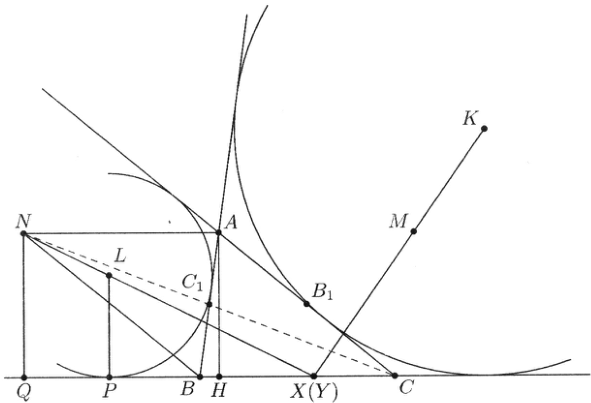
It is well known that the radius of the excircle with the center lying opposite to the vertex C is equal to S/(p−c), so LP=S/(p−c). By condition, AC1=BC1 and since N is symmetric to C about C1, we have NC1=C1C, so ANBC is a parallelogram. If AH is the altitude of ABC, then NQ=AH=2S/a. Since CP=p, CB=a, we have BP=p−a. From the equality of the triangles CHA and BQN it follows that BQ=CH=bcos∠C. Since LP∥NQ, we see that △XLP∼△XNQ. Then XQXP=NQLP. Let BX=x, then
x+bcos∠Cx+p−a=2S/aS/(p−c)⇒x=c−b2(p−c)(p−a)−abcos∠C
Similarly, if y=CY, then y=b−c2(p−b)(p−a)−accos∠B. To prove the required statement, it suffices to show that x+y=a. Indeed,
x+y=c−b2(p−c)(p−a)−abcos∠C+b−c2(p−b)(p−a)−accos∠B==c−b2(p−c)(p−a)−2(p−b)(p−a)+accos∠B−abcos∠C==c−b2(b−c)(p−a)+ac⋅2aca2+c2−b2−ab⋅2aba2+b2−c2==c−b(b−c)(b+c−a)+c2−b2=c−ba(c−b)=a.