Two circles and are externally tangent and both lie in a square with side length so that touches the sides and , while touches the sides and . Prove that the area of at least one of the triangles , is no more than . (Tomáš Jurík)
Czech and Slovak Mathematical Olympiad
Solutions — 2
Solution 1
The line segments and lie on the diagonals of the given square, so they are perpendicular to each other and intersect at the center of the square. We have
Therefore, the area of the triangle is
while the area of the triangle is
The sum of these areas is
Let denote the point at which the circle touches the side , and denote the points at which touches the sides and , respectively, and be the intersection point of the lines and (Fig. 1).
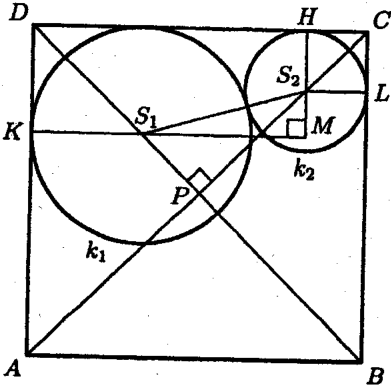
Fig. 1
By the Pythagoras' theorem for the triangle , we have
Hence we obtain
i. e.
The length of the segment cannot be greater than the length of the polygonal chain , so
(This follows from the equality as well since , by the AM-GM inequality.) Therefore,
This means that at least one of the areas , is at most .
Solution 2
We can set . The difference of the areas of the triangles and is (according to the expression from the original solution)
Without loss of generality, we can assume that . Then . Now, let us calculate the area of the triangle . By the Pythagoras' theorem, we have , hence , so . Let us denote . It follows from the inequalities and that , and, on the other hand, we have since the circle lies in the square . Hence it follows that . The area of the triangle is
as we have . Therefore, .
Want a route through all this instead of an archive? The track
puts 2,604 problems in a working order, from Junior Challenge level to the IMO shortlist.