Olympiad Maths Prep

Library / /13 of 13

Geometry Difficulty 8.9 Shortlist Prove it IMO

Let A1A2AnA_{1} A_{2} \ldots A_{n} be a convex polygon. Point PP inside this polygon is chosen so that its projections P1,,PnP_{1}, \ldots, P_{n} onto lines A1A2,,AnA1A_{1} A_{2}, \ldots, A_{n} A_{1} respectively lie on the sides of the polygon. Prove that for arbitrary points X1,,XnX_{1}, \ldots, X_{n} on sides A1A2,,AnA1A_{1} A_{2}, \ldots, A_{n} A_{1} respectively,
max{X1X2P1P2,,XnX1PnP1}1 \max \left\{\frac{X_{1} X_{2}}{P_{1} P_{2}}, \ldots, \frac{X_{n} X_{1}}{P_{n} P_{1}}\right\} \geq 1

Solutions — 2

Solution 1

Denote Pn+1=P1,Xn+1=X1,An+1=A1P_{n+1}=P_{1}, X_{n+1}=X_{1}, A_{n+1}=A_{1}.

Lemma. Let point QQ lies inside A1A2AnA_{1} A_{2} \ldots A_{n}. Then it is contained in at least one of the circumcircles of triangles X1A2X2,,XnA1X1X_{1} A_{2} X_{2}, \ldots, X_{n} A_{1} X_{1}.

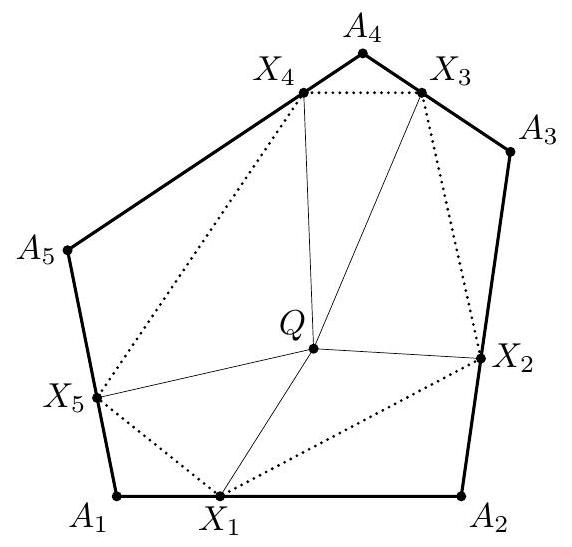
Proof. If QQ lies in one of the triangles X1A2X2,,XnA1X1X_{1} A_{2} X_{2}, \ldots, X_{n} A_{1} X_{1}, the claim is obvious. Otherwise QQ lies inside the polygon X1X2XnX_{1} X_{2} \ldots X_{n} (see Fig. 1). Then we have
(X1A2X2+X1QX2)++(XnA1X1+XnQX1)=(X1A1X2++XnA1X1)+(X1QX2++XnQX1)=(n2)π+2π=nπ \begin{aligned} & \left(\angle X_{1} A_{2} X_{2}+\angle X_{1} Q X_{2}\right)+\cdots+\left(\angle X_{n} A_{1} X_{1}+\angle X_{n} Q X_{1}\right) \\ & \quad=\left(\angle X_{1} A_{1} X_{2}+\cdots+\angle X_{n} A_{1} X_{1}\right)+\left(\angle X_{1} Q X_{2}+\cdots+\angle X_{n} Q X_{1}\right)=(n-2) \pi+2 \pi=n \pi \end{aligned}
hence there exists an index ii such that XiAi+1Xi+1+XiQXi+1πnn=π\angle X_{i} A_{i+1} X_{i+1}+\angle X_{i} Q X_{i+1} \geq \frac{\pi n}{n}=\pi. Since the quadrilateral QXiAi+1Xi+1Q X_{i} A_{i+1} X_{i+1} is convex, this means exactly that QQ is contained the circumcircle of XiAi+1Xi+1\triangle X_{i} A_{i+1} X_{i+1}, as desired. \square

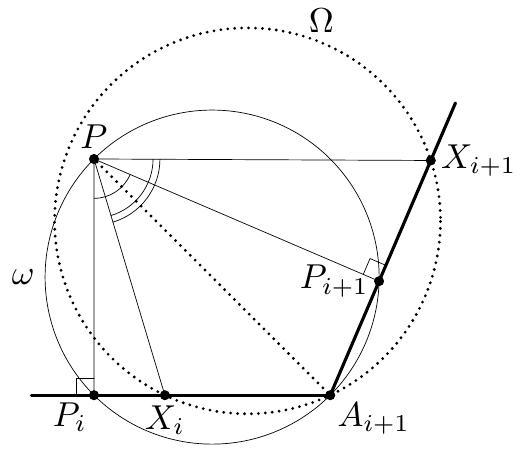
Now we turn to the solution. Applying lemma, we get that PP lies inside the circumcircle of triangle XiAi+1Xi+1X_{i} A_{i+1} X_{i+1} for some ii. Consider the circumcircles ω\omega and Ω\Omega of triangles PiAi+1Pi+1P_{i} A_{i+1} P_{i+1} and XiAi+1Xi+1X_{i} A_{i+1} X_{i+1} respectively (see Fig. 2); let rr and RR be their radii. Then we get 2r=Ai+1P2R2 r=A_{i+1} P \leq 2 R (since PP lies inside Ω\Omega ), hence
PiPi+1=2rsinPiAi+1Pi+12RsinXiAi+1Xi+1=XiXi+1, P_{i} P_{i+1}=2 r \sin \angle P_{i} A_{i+1} P_{i+1} \leq 2 R \sin \angle X_{i} A_{i+1} X_{i+1}=X_{i} X_{i+1},
QED.

Figure 1
Fig. 1
Figure 2
Fig. 2

Solution 2

As in Solution 1, we assume that all indices of points are considered modulo nn.

We will prove a bit stronger inequality, namely
max{X1X2P1P2cosα1,,XnX1PnP1cosαn}1, \max \left\{\frac{X_{1} X_{2}}{P_{1} P_{2}} \cos \alpha_{1}, \ldots, \frac{X_{n} X_{1}}{P_{n} P_{1}} \cos \alpha_{n}\right\} \geq 1,
where αi(1in)\alpha_{i}(1 \leq i \leq n) is the angle between lines XiXi+1X_{i} X_{i+1} and PiPi+1P_{i} P_{i+1}. We denote βi=AiPiPi1\beta_{i}=\angle A_{i} P_{i} P_{i-1} and γi=Ai+1PiPi+1\gamma_{i}=\angle A_{i+1} P_{i} P_{i+1} for all 1in1 \leq i \leq n.

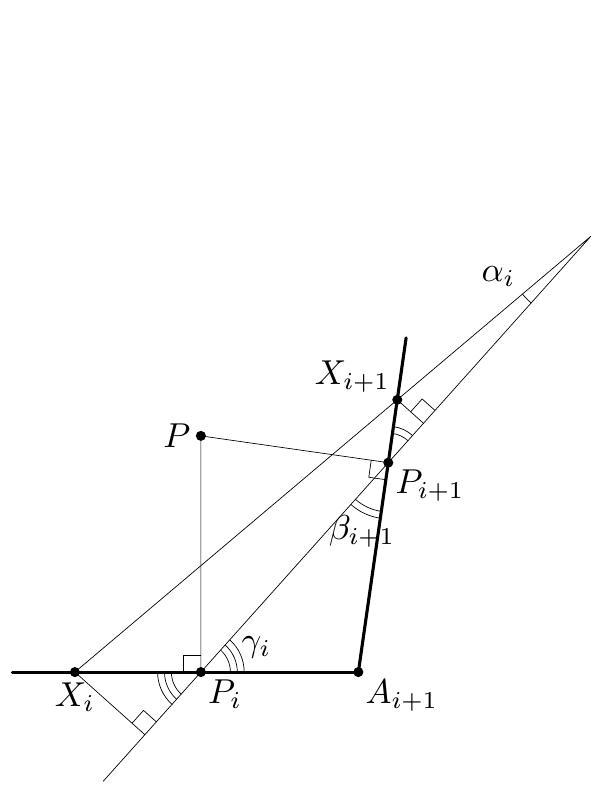
Suppose that for some 1in1 \leq i \leq n, point XiX_{i} lies on the segment AiPiA_{i} P_{i}, while point Xi+1X_{i+1} lies on the segment Pi+1Ai+2P_{i+1} A_{i+2}. Then the projection of the segment XiXi+1X_{i} X_{i+1} onto the line PiPi+1P_{i} P_{i+1} contains segment PiPi+1P_{i} P_{i+1}, since γi\gamma_{i} and βi+1\beta_{i+1} are acute angles (see Fig. 3). Therefore, XiXi+1cosαiPiPi+1X_{i} X_{i+1} \cos \alpha_{i} \geq P_{i} P_{i+1}, and in this case the statement is proved.

So, the only case left is when point XiX_{i} lies on segment PiAi+1P_{i} A_{i+1} for all 1in1 \leq i \leq n (the case when each XiX_{i} lies on segment AiPiA_{i} P_{i} is completely analogous).

Now, assume to the contrary that the inequality
XiXi+1cosαi<PiPi+1 \begin{equation*} X_{i} X_{i+1} \cos \alpha_{i}<P_{i} P_{i+1} \tag{1} \end{equation*}
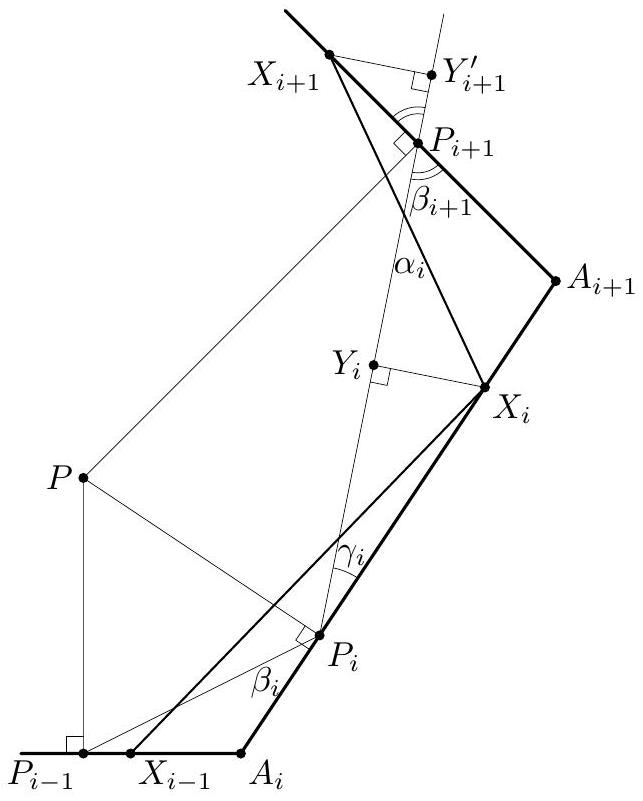
holds for every 1in1 \leq i \leq n. Let YiY_{i} and Yi+1Y_{i+1}^{\prime} be the projections of XiX_{i} and Xi+1X_{i+1} onto PiPi+1P_{i} P_{i+1}. Then inequality (1) means exactly that YiYi+1<PiPi+1Y_{i} Y_{i+1}^{\prime}<P_{i} P_{i+1}, or PiYi>Pi+1Yi+1P_{i} Y_{i}>P_{i+1} Y_{i+1}^{\prime} (again since γi\gamma_{i} and βi+1\beta_{i+1} are acute; see Fig. 4). Hence, we have
XiPicosγi>Xi+1Pi+1cosβi+1,1in. X_{i} P_{i} \cos \gamma_{i}>X_{i+1} P_{i+1} \cos \beta_{i+1}, \quad 1 \leq i \leq n .
Multiplying these inequalities, we get
cosγ1cosγ2cosγn>cosβ1cosβ2cosβn. \begin{equation*} \cos \gamma_{1} \cos \gamma_{2} \cdots \cos \gamma_{n}>\cos \beta_{1} \cos \beta_{2} \cdots \cos \beta_{n} . \tag{2} \end{equation*}
On the other hand, the sines theorem applied to triangle PPiPi+1P P_{i} P_{i+1} provides
PPiPPi+1=sin(π2βi+1)sin(π2γi)=cosβi+1cosγi. \frac{P P_{i}}{P P_{i+1}}=\frac{\sin \left(\frac{\pi}{2}-\beta_{i+1}\right)}{\sin \left(\frac{\pi}{2}-\gamma_{i}\right)}=\frac{\cos \beta_{i+1}}{\cos \gamma_{i}} .
Multiplying these equalities we get
1=cosβ2cosγ1cosβ3cosγ2cosβ1cosγn 1=\frac{\cos \beta_{2}}{\cos \gamma_{1}} \cdot \frac{\cos \beta_{3}}{\cos \gamma_{2}} \cdots \frac{\cos \beta_{1}}{\cos \gamma_{n}}
which contradicts (2).

Figure 3
Fig. 3
Figure 4
Fig. 4

Looking for a route rather than an archive? The track puts 2,000 problems in a working order, from AMC 10 level to the IMO shortlist.

Source: MathNet, licensed CC-BY-4.0. Statement and solution reproduced as published; topic and difficulty added by this site.