a) Rectangle is partitioned into squares, each of which has integer perimeter. Is it true that has integer perimeter?
b) Square is partitioned into squares, each of which has integer perimeter. Is it true that has integer perimeter?
a) Rectangle is partitioned into squares, each of which has integer perimeter. Is it true that has integer perimeter?
b) Square is partitioned into squares, each of which has integer perimeter. Is it true that has integer perimeter?
a)
We construct a counterexample. Consider two squares and with side length . Then, perimeter of the rectangle is — non-integer, while both squares have integer perimeter.
b)
Consider the side of the external square, and all squares that have one side which belongs to the side of the external square (see figure 1).
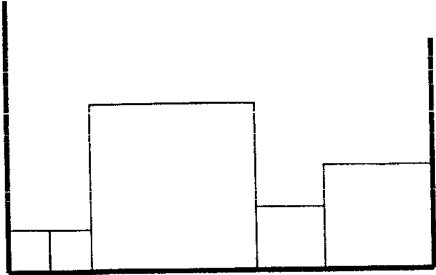
Let be the side of the external square, and the sides of small squares are . Then , and each side , after multiplying by , is integer. Therefore, perimeter of our square is — integer.