Maths Olympiad Prep

Library / /123 of 155

Geometry Difficulty 6.8 National olympiad Prove it Saudi Arabia

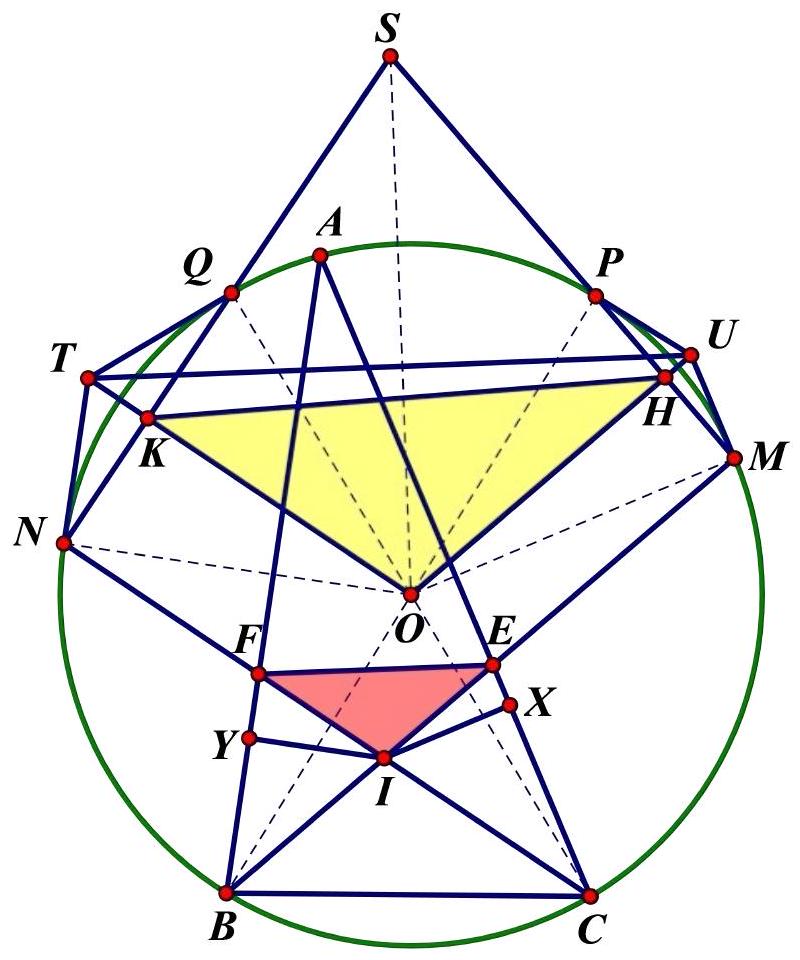
Let ABCABC be a non-isosceles triangle inscribed in a circle (O)(O) and BEBE, CFCF are two angle bisectors intersecting at II with EE belonging to segment ACAC and FF belonging to segment ABAB. Suppose that BEBE, CFCF intersect (O)(O) at MM, NN respectively. The line d1d_{1} passes through MM and is perpendicular to BMBM, intersecting (O)(O) at the second point PP; the line d2d_{2} passes through NN and is perpendicular to CNCN, intersecting (O)(O) at the second point QQ. Denote HH, KK as the midpoints of MPMP and NQNQ respectively.

1. Prove that triangles IEFIEF and OKHOKH are similar.

2. Suppose that SS is the intersection of the two lines d1d_{1} and d2d_{2}. Prove that SOSO is perpendicular to EFEF.

Solution

1) Denote the projections of II on ACAC, ABAB are XX, YY respectively.
Note that BB, OO, PP are collinear because BMP=90\angle BMP = 90^\circ. Because OO, HH are the midpoints of PBPB, PMPM respectively, we have OHBMOH \parallel BM and OH=12BMOH = \frac{1}{2} BM.
Similarly, OKCNOK \parallel CN and OK=12CNOK = \frac{1}{2} CN. Hence, HOK=EIF\angle HOK = \angle EIF. On the other hand,
OHOK=BMCN=sin(A+B2)sin(A+C2)IFIE=IYsinIFY:IXsinIEX=sinIEXsinIFY=sin(A+B2)sin(A+C2) \begin{aligned} & \frac{OH}{OK} = \frac{BM}{CN} = \frac{\sin \left(A + \frac{B}{2}\right)}{\sin \left(A + \frac{C}{2}\right)} \\ & \frac{IF}{IE} = \frac{IY}{\sin \angle IFY} : \frac{IX}{\sin \angle IEX} = \frac{\sin \angle IEX}{\sin \angle IFY} = \frac{\sin \left(A + \frac{B}{2}\right)}{\sin \left(A + \frac{C}{2}\right)} \end{aligned}
So OHOK=IFIE\frac{OH}{OK} = \frac{IF}{IE} implies that OHKIFE\triangle OHK \sim \triangle IFE.

Figure 1

2) It is easy to see that
OKOT=R2,OHOU=R2 OK \cdot OT = R^2, \quad OH \cdot OU = R^2
with RR the radius of (O)(O). Then OKOT=OHOUOK \cdot OT = OH \cdot OU or KK, TT, HH, OO are cyclic.
From this, we can see IEF=IKH=IUT\angle IEF = \angle IKH = \angle IUT so EFUTEF \parallel UT.
The antipole line of TT, UU passes through SS so the antipole line of SS is TUTU, which leads to TUSOTU \perp SO. From these results, we get SOEFSO \perp EF.

Want a route through all this instead of an archive? The track puts 2,000 problems in a working order, from AMC 10 level to the IMO shortlist.

Source: MathNet, licensed CC-BY-4.0. Statement and solution reproduced as published; topic and difficulty added by this site.