Let F be the diametrically opposite point to D on k. Since F is a point on the bisector of BC, we have FB=FC, and therefore ∠BEF=∠CEF.
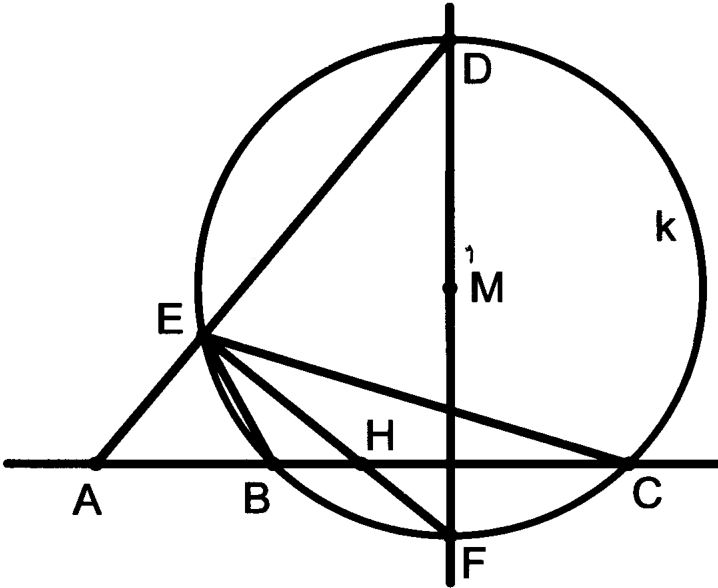
We see that EF is the internal bisector of ∠BEC, and since ED⊥EF, ED=AD is the external bisector. If we name BC∩EF=H, we see that A and H are harmonic with respect to B and C, since they are the points of intersection of perpendicular bisectors EA and EF with BC. Since A is independent of the choice of k, we see that H must be as well, and since BC:CE=BH:CH, the ratio is independent of the choice of k, as claimed. □