Find all possibilities: how many acute angles can there be in a convex polygon?
Estonia — Open Contests
Solution
A square has 0 acute angles, a right-angled trapezium has 1 acute angle, an obtuse triangle has 2 acute angles, an acute triangle has 3.
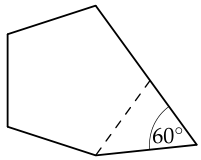
Fig. 1
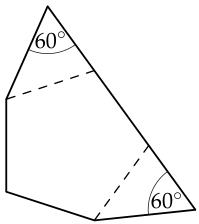
Fig. 2
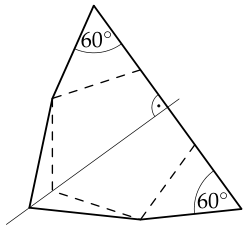
Fig. 3
Let us show that 4 or more acute angles is not possible. By moving along the boundary of the convex polygon, we turn at vertices in only one direction (for example left), and on arrival at the initial vertex we have turned a total of . In an acute-angled vertex the direction changes by more than (the change of direction equals the size of the respective exterior angle which is obtuse in this case). Thus if in the polygon there were 4 or more acute angles, the total turn in only those would be more than .
Solution 2:
In a regular pentagon all angles have size or , thus there are 0 acute angles. By prolonging two sides in one direction, the angle of the pentagon at the moving vertex is reduced. As the angle between the extensions of two non-neighbouring sides is , which equals , the receding angle can be given size without losing the convexity of the polygon (Fig. 1). By prolonging the already prolonged side in the other direction, we can similarly create another acute angle of size (Fig. 2). Finally let us move the opposite vertex of the prolonged side away from that side. This can be done without losing convexity until there is an acute angle also at that vertex (Fig. 3). Indeed, as in this process the unchanging angles have size , totalling , the convexity of the pentagon is lost only when the size of the reducing angle reaches , when the pentagon becomes a regular triangle.
On the other hand, when angles of a convex -gon are acute, then the sum of their sizes is less than and the sum of the sizes of the other angles is less than . But the sum of the sizes of the interior angles of any -gon is . Therefore we get , whence and . Thus there can only be 0 to 3 acute angles in a convex -gon.
Want a route through all this instead of an archive? The track
puts 2,604 problems in a working order, from Junior Challenge level to the IMO shortlist.