Let be an acute, non-isosceles triangle, , , are the altitudes with , , belonging to , , respectively. Respectively denote , , as the circumcircles of triangles , , . Suppose that is a circle that is internally tangent to , , . Prove that is tangent to the circumcircle of triangle .
Saudi Arabian Mathematical Competitions
Solution
Let be the orthocenter of triangle .
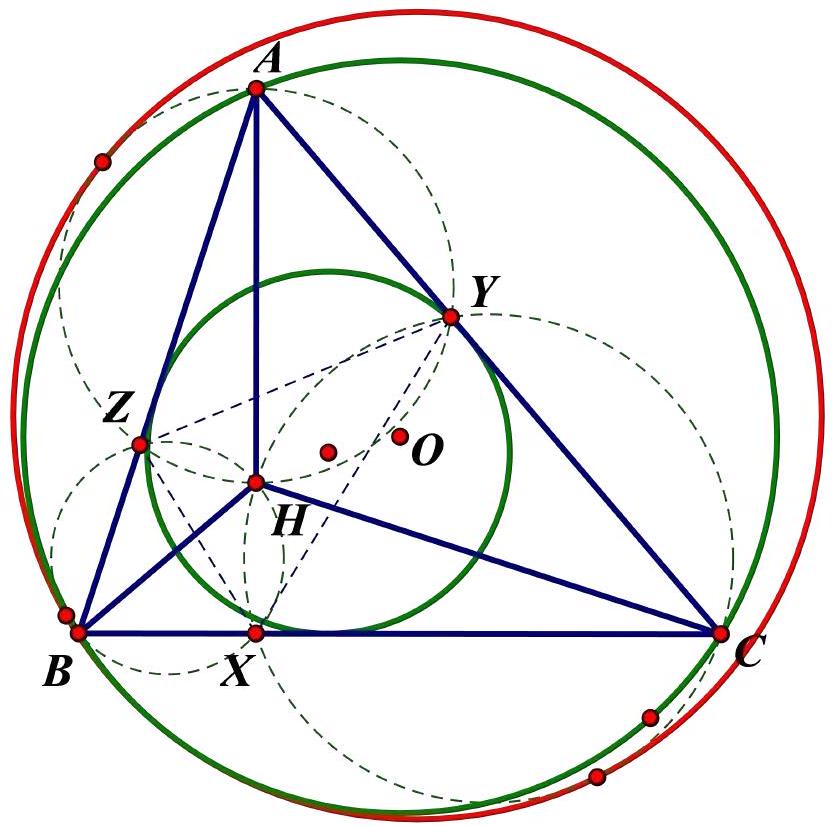
We can see that . We consider the inversion with center and ratio as the function .
It is easy to see that
so with being the 9-point circle (which also passes through , , ).
On the other hand, because , hence . After the inversion, the circles become a line passing through the images of , ; indeed, this line is or .
Similarly, we also have and . So the circle that is tangent to , , will become the incircle of triangle . But based on Feuerbach's theorem, the two circles , are tangent to each other.
Therefore, the circles and are also tangent to each other.
Want a route through all this instead of an archive? The track
puts 2,604 problems in a working order, from Junior Challenge level to the IMO shortlist.