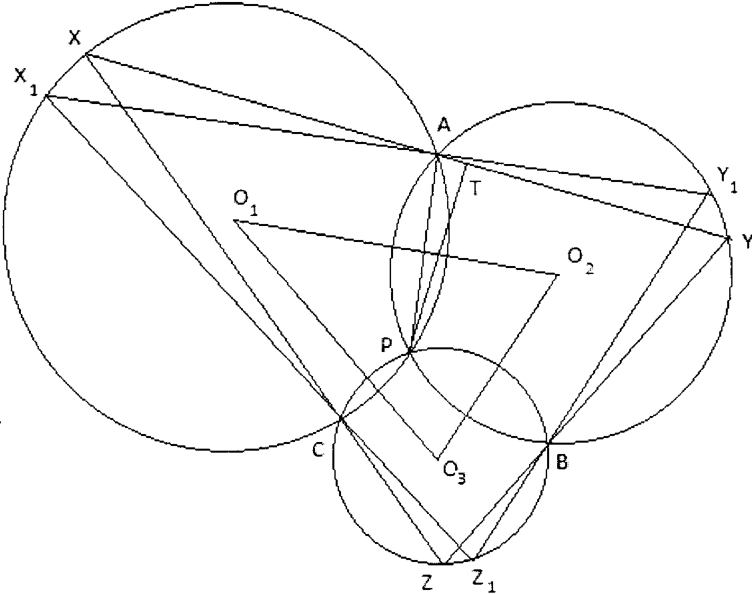
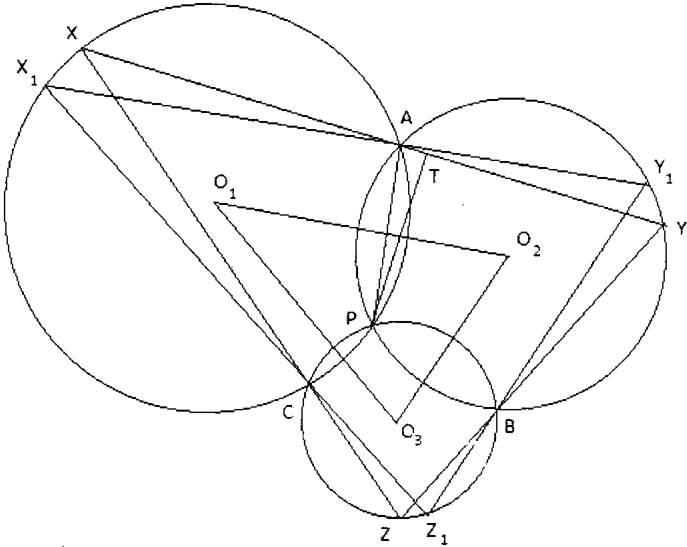
We will first show that the points Y, B and Z are collinear. Since the quadrilateral BYAP is inscribed we have ∠PBY=∠PAX. Since the quadrilateral AXCP is inscribed we have ∠PAX=∠PCZ. Since the quadrilateral CPBZ is inscribed we obtain ∠PBZ+∠PCZ=180∘. Therefore ∠YBZ=∠YBP+∠PBZ=180∘.
Let us notice that ∠CO1O3=∠PO1O3 and ∠AO1O2=∠PO1O2, from where it follows that ∠O2O1O3=21∠AO1C=∠AXC. Similarly ∠O1O2O3=∠AYB and ∠O1O3O2=∠CZB. It follows that △XYZ∼△O1O2O3, with which we've proven the statement under a).
Let the line X1Y1 be parallel to O1O2 and pass through A, where X1 lies on k1 and Y1 lies on k2. Let Z1 be the intersection of the line X1C with the circle k3. From the afore-proven, the points Y1, B and Z1 are collinear and △X1Y1Z1∼△O1O2O3. Furthermore, ∠PXA=∠PX1A and ∠PYA=∠PY1A. Therefore △PXY∼△PX1Y1. Let PT be the altitude dropped from the vertex P to the side XY. PA is the altitude of the triangle PX1Y1. Since PA is a hypotenuse in the right-angled triangle PAT we get PT≤PA. Therefore PPXY≤PPX1Y1 and analogously PPYZ≤PPY1Z1 and PPXZ≤PPX1Z1. From this we get PXYZ≤PX1Y1Z1. The points P, O1 and X1 are collinear since ∠PAX1=90∘. Similarly P, O2 and Y1 are collinear and P, O3 and Z1 are collinear. We get that O1O2, O1O3 and O2O3 are midsegments in the triangles X1Y1P, X1Z1P and Y1Z1P respectively, and so PX1Y1Z1=4PO1O2O3. This gives us the required inequality. Equality is attained when the points X and X1 coincide, and with that the points Y and Y1 as well as the points Z and Z1 coincide.