The river city of Platense consists of several platforms and bridges between them. Each bridge connects two platforms and no two bridges are connecting the same two platforms. The mayor wants to change some bridges through a series of moves as follows: if there are three platforms , and , and bridges and but not , then can be changed to .
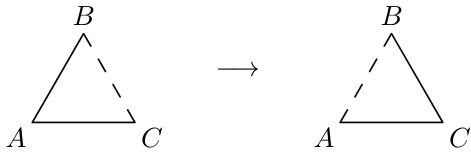
A bridge configuration is good if you can go from any platform to any other using only the bridges. Starting from a good configuration, show that the mayor can reach any other good configuration, whose number of bridges is the same, through the movements described.
Rioplatense Mathematical Olympiad
Solution
Let us interpret the problem in terms of graphs. We can think of the initial configuration as a graph whose vertices are the platforms and whose edges are the bridges. This graph is connected. The claim is, then, that can be converted into another graph by rotating edges as in the statement if is connected and has the same number of vertices and edges as . To prove this we will build a normal form of the graph in several steps. Note that, as the operations are invertible, the claim will be proved if this normal form depends only on the number of edges and vertices. We label the vertices of as , and suppose has edges.
STEP 1: Make have degree .
Assume that is not a neighbor of . Since the graph is connected, there is a path connecting to , i.e, there exists a sequence of vertices such that , , and are connected by an edge for all . Let's take one such path with minimal. By our initial assumption we have . Moreover, by minimality, is not connected to for any . Therefore, we can apply the operation to and . In this way, we get a shorter path connecting to without disconnecting . By iterating this procedure we reach a situation in which is a neighbor of , without removing any edges from . So in the end will be connected by an edge to all , and thus its degree will be .

We will refer to this sequence of moves as .
Let be the graph obtained after Step 1, and be the graph obtained by removing vertex (with all its incident edges) from . Let be the connected component of in . Finally, let be the number of edges of , and .
STEP 2: Make the size of equal to .
If is connected, then which has size . We also have , so , and there is nothing to do.
If there is an edge between two vertices and that are not in the same connected component as , we can use to rotate edge into , so now is in as well. We iterate this until it is no longer possible. This is because either is now connected (and we are done), or because all other connected components have size 1 (isolated vertices). In the latter case, observe that now all the edges are in , which is connected, so has at most vertices. If there are exactly vertices, we are done. Otherwise, since the number of edges is greater than or equal to the number of vertices, there is at least one edge that can be removed without disconnecting . So, if there is an isolated vertex , using we can rotate into , which adds to . We can keep doing this until either or we run out of edges, i.e., the size of is .
STEP 3: Make connected to .
First we proceed as in Step 1 to make sure that is connected to all vertices in . If , we are done. Otherwise, there exist and such that is an edge but is not. So we can rotate into , and iterate the process.
After Step 3, we consider the subgraph whose vertices are . This graph is connected and, moreover, is connected to all other vertices, so we are in the same situation we were with , and we can iterate Step 2 and Step 3. This goes on until we run out of edges, and we reach the normal form. Since depends exclusively on and for all , the problem is solved.
Want a route through all this instead of an archive? The track
puts 2,604 problems in a working order, from Junior Challenge level to the IMO shortlist.