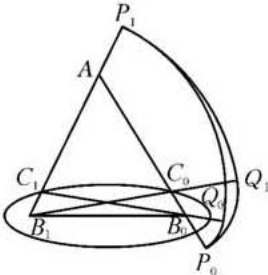
(1) From the properties of an ellipse we know
B1C0+C0B0=B1C1+C1B0.
Also, it is obvious that
B0P0=B0Q0,C1B0+B0Q0=C1P1,
B1C1+C1P1=B1C0+C0Q1,C0Q1=C0B0+B0P0′.
Adding these equations, we get B0P0=B0P0′.
Therefore P0′ and P0 are coincident. Furthermore, as P0, C0 (the center of Q 1P 0) and B0 (the center of P 0Q 0) are lying on the same line, we know that Q 1P 0 and P 0Q 0 are tangent at P0.
(2) We have thus Q 1P 0 and P 0Q 0, P 0Q 0 and Q 0P 1, Q 0P 1 and P 1Q 1, P 1Q 1 and Q 1P’ 0 are tangent at points P0,Q0,P1,Q1 respectively. Now we draw common tangent lines P0T and P1T through P0 and P1 respectively, and suppose the two lines meet at point T. Also, we draw a common
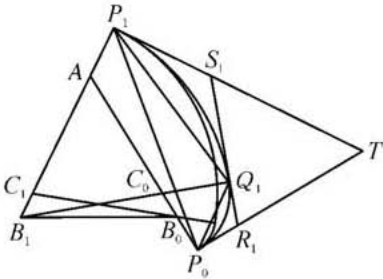
tangent line R1S1 through Q1, and suppose it intercepts P0T and P1T at point R1 and S1 respectively. Drawing segments P0Q1 and P1Q1, we get isosceles triangles P0Q1R1 and P1Q1S1 respectively. Then we have
∠P0Q1P1=π−∠P0Q1R1−∠P1Q1S1=π−(∠P1P0T−∠Q1P0P1)−(∠P0P1T−∠Q1P1P0).
Since
π−∠P0Q1P1=∠Q1P0P1+∠Q1P1P0,
we obtain
∠P0Q1P1=π−21(∠P1P0T+∠P0P1T).
In the same way, we can prove that
∠P0Q0P1=π−21(∠P1P0T+∠P0P1T).
It implies that points P0,Q0,Q1,P1 are concyclic.