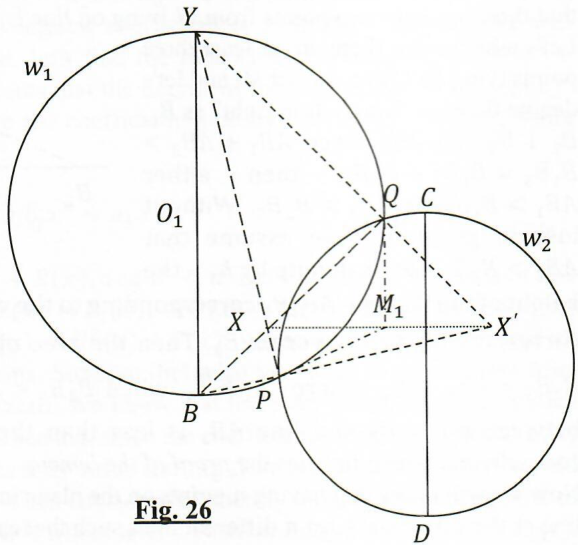
Let O1 be the center of circle w1 and X′=BP∩AQ as on Fig. 26. Since AP⊥BP and BQ⊥AQ, then AP and BQ are heights of the triangle ABX′, and X is the orthocenter. Then X′X is also a height in the triangle, therefore X′X⊥AB and ∠PX′X=90∘−∠ABX′=∠PAB. This implies that triangles △APB and △X′PX have the same angles, so there is a rotation and homothety that transform triangle △APB into △X′PX. The center of transformations is at P, the rotation is by 90∘ and the homothety coefficient is BPXP=∠XBP=21∠QO1P.
Denote by M1 the midpoint of XX′. The segments PO1 and PM1 are medians of the triangles △APB and △X′PX respectively, therefore PM1⊥PO1, that is, PM1 is tangent to w1. Similarly, we get that QM1 is tangent to w1 as well. Consequently, M1 is the intersection of tangents to w1 drawn from P and Q that are not dependent on the choice of points A and B. Note that the length of the segment
XX′=AB⋅21∠QO1P
does not depend on A and B as well, because the length of diameter AB and the angle ∠QO1P are constant.
Analogously, we construct the point M2 for the circle w2. Assume that T=XY∩M1M2 (the case when XY∥M1M2 will be considered further). We will show that point T is fixed, which implies that all the lines XY intersect at one point regardless of the choice of diameters AB and CD.
Note that M1X and M2Y are parallel since both are perpendicular to AB∥CD, that is why
M2TM1T=M2YM1X.
The points M1 and M2 as well as the ratio M2YM1X=2YY′2XX′=YY′XX′ are fixed, therefore T is also fixed.
The lines XY and M1M2 are parallel and do not coincide if and only if segments M1X and M2Y are equal and parallel. These properties hold as well with different choices of the diameters AB and CD. Hence, if XY and M1M2 are parallel it will imply that XY is parallel to M1M2 for all other initializations of diameters AB and CD.
The lines XY and M1M2 coincide if and only if AB∥CD⊥M1M2. In this case one may consider another initialization of the diameters AB and CD, that will determine in which of two cases considered above we are. Note, that the initial line XY=M1M2 satisfies both of the considered cases.