On a plane, the band with width is the set of all points whose distance from a line is less than or equal to . There are four points , , , on the plane. If you chose any three points among them, there exists a band with width containing them. Prove that there exists a band with width containing all four points.
Japan competition problems, 2007
Solution
When a group consisting of points in the plane is included in band , we say that band covers . First, we prove the following lemma.
Lemma. For triangle , let be the foot of the perpendicular from to , be the foot of the perpendicular from to , and be the foot of the perpendicular from to . When a band with width covers the triangle , .
Proof of Lemma. Let be a band with width covering triangle . Then, there exists a line and a real number which the following condition holds.
Let be the lines perpendicular to which pass through , , . Then, we can say that at least one of the following proposition holds.
* The common point of and line is covered by .
* The common point of and line is covered by .
* The common point of and line is covered by .
Without loss of generality, assume that covers the point which is the common point of and . Since is a point on line , . On the other hand, , so we get . With that, it can be said that .
If the convex closure of points , , , is a triangle, the problem's statement is trivial. So we can assume that , , , make a convex quadrangle . We are going to show a contradiction, assuming that for any three points among , , , there exists a band with width containing them, and that cannot be covered by a band with width .
Without loss of generality, assume that the area of the triangle is the largest in all triangles constituted by three points among , , , . (Then note that locates in shadow area.) Let be the foot of the perpendicular from to , be the foot of the perpendicular from to , and be the foot of the perpendicular from to . By the lemma, .
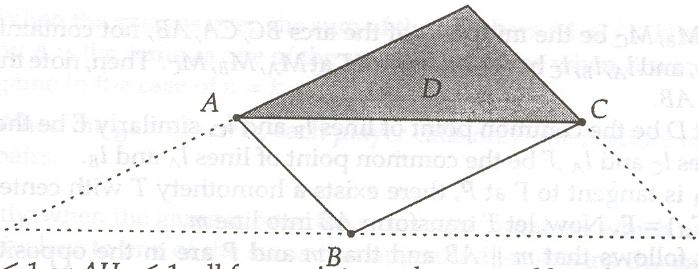
If or , all four points can be covered by a band with width , but this conflicts with our assumption. So we get .
If , it follows that , so all four points can be covered with a band with width . This conflicts with the assumption, so we get . Similarly, it follows that .
Hence, . Thus, at least one of , is wider than . Without loss of generality, we assume that . Let be the foot of the perpendicular from to , be the foot of the perpendicular from to , be the foot of the perpendicular from to . If , all four points can be covered by a band with width . This conflicts with the assumption, so it follows that . Similarly we get . , , so it follows that .
By the lemma, . If , since , and we get . Noting that , we get . Then, . If , since , we get . So it follows that . Then . With that we get in each case. However, when , all four points can be covered by a band with width . This conflicts with our assumption. With that, all four points , , , can be covered by a band with width .
Want a route through all this instead of an archive? The track
puts 2,604 problems in a working order, from Junior Challenge level to the IMO shortlist.