Point is chosen inside isosceles triangle with base and in such a way, that . Let be the feet of perpendicular from to the line which contains the bisector of adjacent angle of . Prove, that .
Mathematical Olympiad in Ukraine, Fourth Round (March 24, ), 2010
Solution
We first show that point is always inside triangle . Consider the case, when lies on the side and compute some angles. Let (Fig.13), then , , , hence, is an isosceles triangle, thus the altitude is also a bisector, therefore belongs to the side . Therefore, as long as is inside the bisector of adjacent angle of forms the least angle with line . Thus, perpendicular from to this line lies between sides and of triangle . Let us extend to the intersection with (Fig.14) (without loss of generality, we can assume that is closer to than to ).
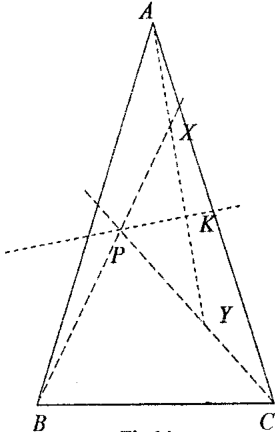
Fig. 14
In the same way, meets at point . Then, in segment is a bisector and an altitude, thus, it is isosceles or , from which it follows that . If we now denote , , , , then , , moreover, . From last two identities, we get , . Hence, (they have two equal sides and angle between them).
We have the following equalities: , which is exactly what we wanted to prove.
Want a route through all this instead of an archive? The track
puts 2,604 problems in a working order, from Junior Challenge level to the IMO shortlist.