Maths Olympiad Prep

Library / Hellenic Mathematical Olympiad /44 of 57

Hellenic Mathematical Olympiad

Geometry Difficulty 6.7 National Olympiad Prove it Greece

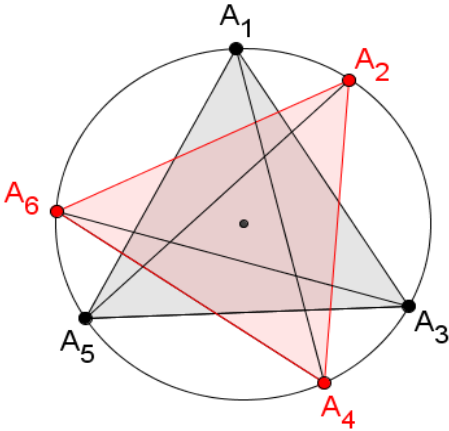
Let z1,z2,z3,z4,z5,z6z_1, z_2, z_3, z_4, z_5, z_6 be six pairwise different complex numbers which their images A1,A2,A3,A4,A5,A6A_1, A_2, A_3, A_4, A_5, A_6 are consecutive points of the circle with center O(0,0)O(0,0) and radius r>0r > 0. If ww is a solution of the equation z2+z+1=0z^2 + z + 1 = 0 and
z1w2+z3w+z5=0(I), z_1 w^2 + z_3 w + z_5 = 0 \quad (I),
z2w2+z4w+z6=0(II) z_2 w^2 + z_4 w + z_6 = 0 \quad (II)
Prove that: (a) the triangle A1A3A5A_1A_3A_5 is equilateral,
∣z1−z2∣+∣z2−z3∣+∣z3−z4∣+∣z4−z5∣+∣z5−z6∣+∣z6−z1∣=3∣z1−z4∣=3∣z2−z5∣=3∣z3−z6∣. |z_1 - z_2| + |z_2 - z_3| + |z_3 - z_4| + |z_4 - z_5| + |z_5 - z_6| + |z_6 - z_1| = 3|z_1 - z_4| = 3|z_2 - z_5| = 3|z_3 - z_6|.

Solution

(a) Since ww is a root of the equation z2+z+1=0z^2 + z + 1 = 0, we have w2+w+1=0w^2 + w + 1 = 0. Multiplying both parts by ww:
w3+w2+w=0⇔w3+w2+w+1⏟0=1⇔w3=1. w^3 + w^2 + w = 0 \Leftrightarrow w^3 + \underbrace{w^2 + w + 1}_{0} = 1 \Leftrightarrow w^3 = 1.
From the last equation we find ∣w∣=1|w| = 1. Substituting in relation (I) w2=−w−1w^2 = -w - 1, we find:
z1(−1−w)+z3w+z5=0⇔−z1−z1w+z3w+z5=0⇔(z3−z1)w=z1−z5. z_1(-1-w) + z_3w + z_5 = 0 \Leftrightarrow -z_1 - z_1w + z_3w + z_5 = 0 \Leftrightarrow (z_3 - z_1)w = z_1 - z_5.
Hence
∣(z3−z1)w∣=∣z1−z5∣⇔∣z3−z1∣∣w∣=∣z1−z5∣⇔∣z3−z1∣=∣z1−z5∣(A). |(z_3 - z_1)w| = |z_1 - z_5| \Leftrightarrow |z_3 - z_1| |w| = |z_1 - z_5| \Leftrightarrow \boxed{|z_3 - z_1| = |z_1 - z_5|} \quad (A).
Substituting in relation (I) w=−w2−1w = -w^2 - 1, we find:
z1w2+z3(−w2−1)+z5=0⇔z1w2−z3w2−z3+z5=0⇔(z1−z3)w2=z5−z3. z_1 w^2 + z_3(-w^2 - 1) + z_5 = 0 \Leftrightarrow z_1 w^2 - z_3 w^2 - z_3 + z_5 = 0 \Leftrightarrow (z_1 - z_3)w^2 = z_5 - z_3.
Hence we have
∣(z1−z3)w∣2=∣z5−z3∣2⇔∣z1−z3∣2∣w∣2=∣z5−z3∣2⇔∣z3−z1∣=∣z5−z3∣(B). |(z_1 - z_3)w|^2 = |z_5 - z_3|^2 \Leftrightarrow |z_1 - z_3|^2 |w|^2 = |z_5 - z_3|^2 \Leftrightarrow \boxed{|z_3 - z_1| = |z_5 - z_3|} \quad (B).
From (A) and (B) we obtain the equalities:
∣z1−z3∣=∣z3−z5∣=∣z5−z1∣, |z_1 - z_3| = |z_3 - z_5| = |z_5 - z_1|,
that is the triangle A1A3A5A_1A_3A_5 is equilateral..

(β) Similarly, using relation (II) we prove that the triangle A2A4A6A_2A_4A_6 is equilateral. From a known proposition of Euclidean Geometry we have that A1A2+A1A6=A1A4A_1A_2 + A_1A_6 = A_1A_4, and then using measures of complex numbers we have:

∣z1−z2∣+∣z6−z1∣=∣z1−z4∣.(1) |z_1 - z_2| + |z_6 - z_1| = |z_1 - z_4|. \qquad (1)
Similarly, from the equality A3A2+A3A4=A3A6A_3A_2 + A_3A_4 = A_3A_6 using measures of complex numbers we get:
∣z2−z3∣+∣z3−z4∣=∣z3−z6∣.(2) |z_2 - z_3| + |z_3 - z_4| = |z_3 - z_6|. \qquad (2)
Also, from equality A5A4+A5A6=A5A2A_5A_4 + A_5A_6 = A_5A_2 we find:
∣z4−z5∣+∣z5−z6∣=∣z2−z5∣.(3) |z_4 - z_5| + |z_5 - z_6| = |z_2 - z_5|. \qquad (3)
Figure 1
Summing up by parts the relations (1), (2) and (3) and using the equalities
∣z1−z4∣=∣z3−z6∣=∣z2−z5∣ |z_1 - z_4| = |z_3 - z_6| = |z_2 - z_5|
we find:
∣z1−z2∣+∣z2−z3∣+∣z3−z4∣+∣z4−z5∣+∣z5−z6∣+∣z6−z1∣=3∣z1−z4∣=3∣z2−z5∣=3∣z3−z6∣. |z_1 - z_2| + |z_2 - z_3| + |z_3 - z_4| + |z_4 - z_5| + |z_5 - z_6| + |z_6 - z_1| = \\ 3|z_1 - z_4| = 3|z_2 - z_5| = 3|z_3 - z_6|.

Want a route through all this instead of an archive? The track puts 2,604 problems in a working order, from Junior Challenge level to the IMO shortlist.

Source: MathNet, licensed CC-BY-4.0. Statement reproduced verbatim; metadata (topic, difficulty) added by this project.