Let be a triangle with . Let and be two different points on line such that and is located between and . Suppose that there exists an interior point of segment for which . Let the ray intersect the circle at . Prove that .
IMO Shortlist
Solutions — 3
Solution 1
Denote by the circumcircle of the triangle , and let . Note that the condition implies . Since , the line is tangent to , so . By the triangles and are similar, and .
Next, since , the triangles and are also similar. Then , which means that the points , and are concyclic. Therefore .
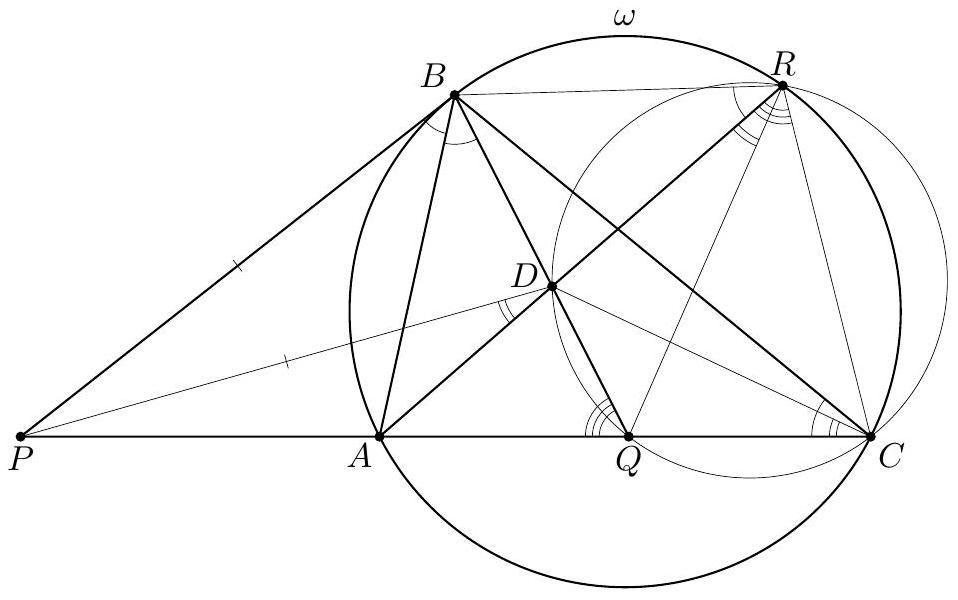
Figure 1
Now from and we get
so the triangle is isosceles, which yields .
Solution 2
Again, denote by the circumcircle of the triangle . Denote . Since , the line is tangent to .
Let be the second intersection point of with . If is any point on the ray beyond , then ; together with this shows firstly, that the rays and intersect at some point , and secondly that the triangle is similar to the triangle . Thus we have . Next, ; so the triangles and are also similar.
Let be an altitude in the isosceles triangle ; then . Let be the intersection point of and . By the symmetry with respect to , we have ; thus and hence . Thus the points and correspond to each other in the similar triangles and , so . Thus .
Let be the common point of and , and let be an altitude in the triangle . The points and are the feet of corresponding altitudes in the similar triangles and , so . On the other hand, the points and are feet of corresponding altitudes in the similar triangles and , so . Thus , and the triangles and are similar.
Finally, is a median in the right-angled triangle ; so , and hence .
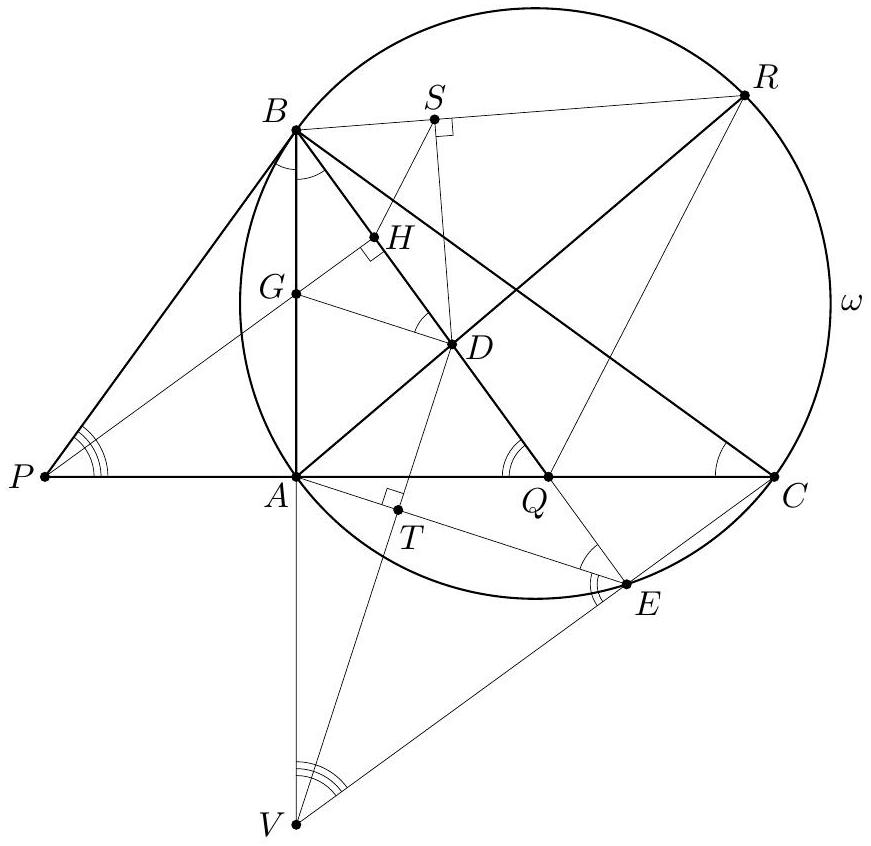
Figure 2
Solution 3
Denote by and the circumcircle of the triangle and its center, respectively. From the condition we know that is tangent to .
Let be the second point of intersection of and . Due to the isosceles triangle , the tangent of at is parallel to and consequently it intersects at some point . Of course, . Let be the midpoint of , and let be the midpoint of . Notice that , so lies on the perpendicular bisector of ; thus the points , and are collinear. Let be the circle with diameter . Let ; since is the perpendicular bisector of , the statement of the problem is equivalent to .
Consider the following sequence of projections (see Fig. 3).
1. Project the line to the line through the center . (This maps to .)
2. Project the line to in parallel direction with . (.)
3. Project the line to the circle through its point . (.)
4. Scale by the ratio from the point to the circle . (.)
5. Project to the line through its point . (.)
We prove that the composition of these transforms, which maps the line to itself, is the identity. To achieve this, it suffices to show three fixed points. An obvious fixed point is which is fixed by all the transformations above. Another fixed point is , its path being .
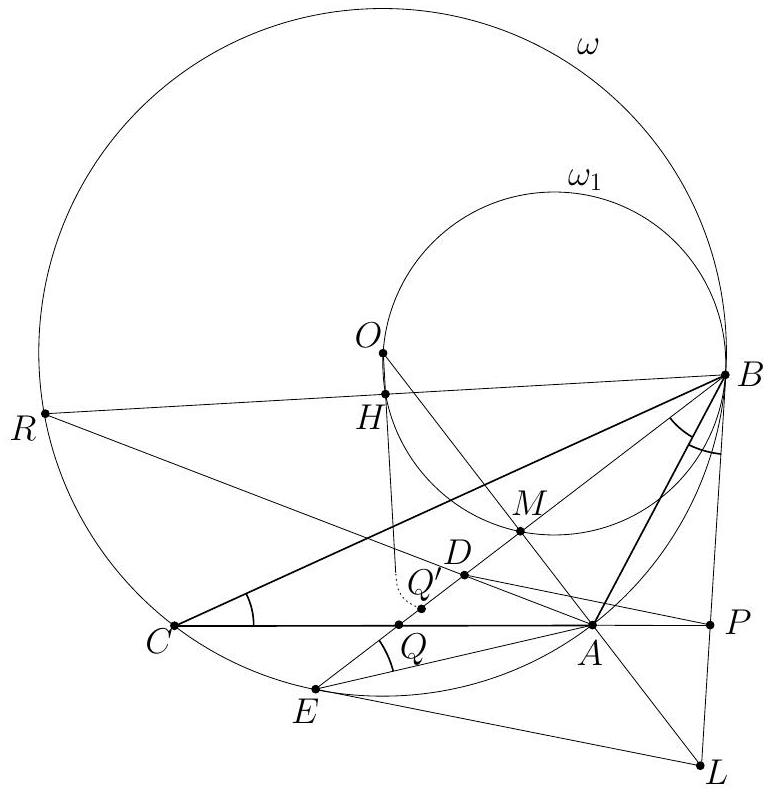
Figure 3
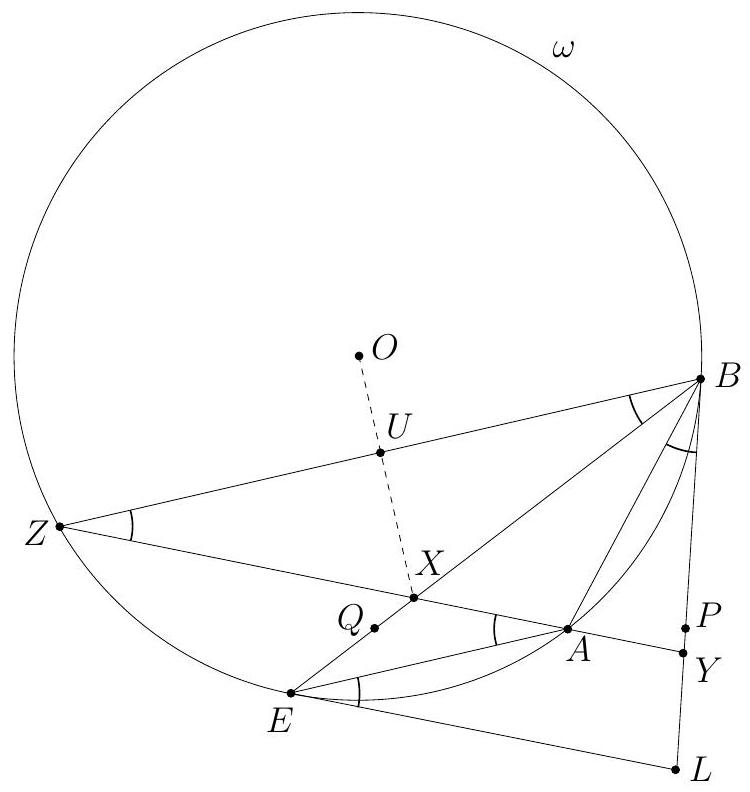
Figure 4
In order to show a third fixed point, draw a line parallel with through ; let that line intersect and at and , respectively (see Fig. 4). We show that is a fixed point. The images of at the first three transformations are . From we can see that the triangle is isosceles. Let be the midpoint of ; then the last two transformations do , and the point is fixed.
Want a route through all this instead of an archive? The track
puts 2,604 problems in a working order, from Junior Challenge level to the IMO shortlist.