Let be a positive integer. Points are placed in a plane in such a way that no 3 points among them lie on any straight line. Furthermore, for each if we rotate the half-line starting at around the point by clockwise, then the half line falls onto the half-line starting at . Determine the maximum possible number of the pairs for which the line segments and intersect at a point different from the end points of the line segments. Here we let and assume that .
Japan Final Round, 2013
Solution
Let for , , , . Also, let and . From now on let us say that the directed line segments are leftward, downward, rightward, upward segments, respectively. Furthermore, let us say a bent line segment is leftdown type for each , and define similarly, downright, rightup, upleft type bent segments.
Then the point of intersection (different from their end-points) of a leftward segment and a downward segment can be regarded as the intersection of two leftdown type bent segments. The same statement can be made for intersections of other types of directed segments. Therefore, to get the answer to the problem, it suffices to find the maximum possible value for the sum of the number of intersections of two leftdown type bent segments, that of two downright bent segments, that of two rightup bent segments and that of two upleft bent segments.
Let us say the pair where is a good pair if for all of the four pairs of bent segments and , and , and , and , two bent segments intersect each other.
We note that if is a good pair and if lies above , then lies to the right of , lies below , lies to the left of and lies below .
Lemma. For any non-empty proper subset of the set , let , the complement of . Then, there exist and such that the pair is not a good pair.
Proof. For , let us define
Now suppose for every choice of and the pair is a good pair. Define and if is located at the -th position from the top among . We show that for each , the number of points among which belong to and the number of points among which belong to must coincide.
In order to show this, let us suppose the number for the former is larger than the number for the latter. Then, there exists for which both and hold. Furthermore, there must exist which satisfies both and , since the number of points in the set which belong to is more than the number of points in the set which belong to . But this implies that the pair is not a good pair contradicting our assumption. Similarly, we arrive at a contradiction also if we assume that the number for the former case is smaller than the number for the latter. Therefore, we conclude that the number for the former equals the number for the latter.
By comparing this fact for the case and for the case , we arrive at the conclusion that
This means that for any we have
But this contradicts our assumption that is a non-empty proper subset of , and this proves the Lemma.
Now, in order to arrive at the answer to the problem, suppose that the number of , which is not a good pair is at most . Then, among the elements of , the number of those which can be reached from the element 1 by going through the string of not-good pairs can be at most . So, let be the subset consisting of those elements accessible from 1 in this way and let be the complement of . Then, we arrive at a situation contradicting the conclusion of the Lemma. So, we must have at least not-good pairs among . Therefore, the maximum number of pairs satisfying the requirement of the problem is at most .
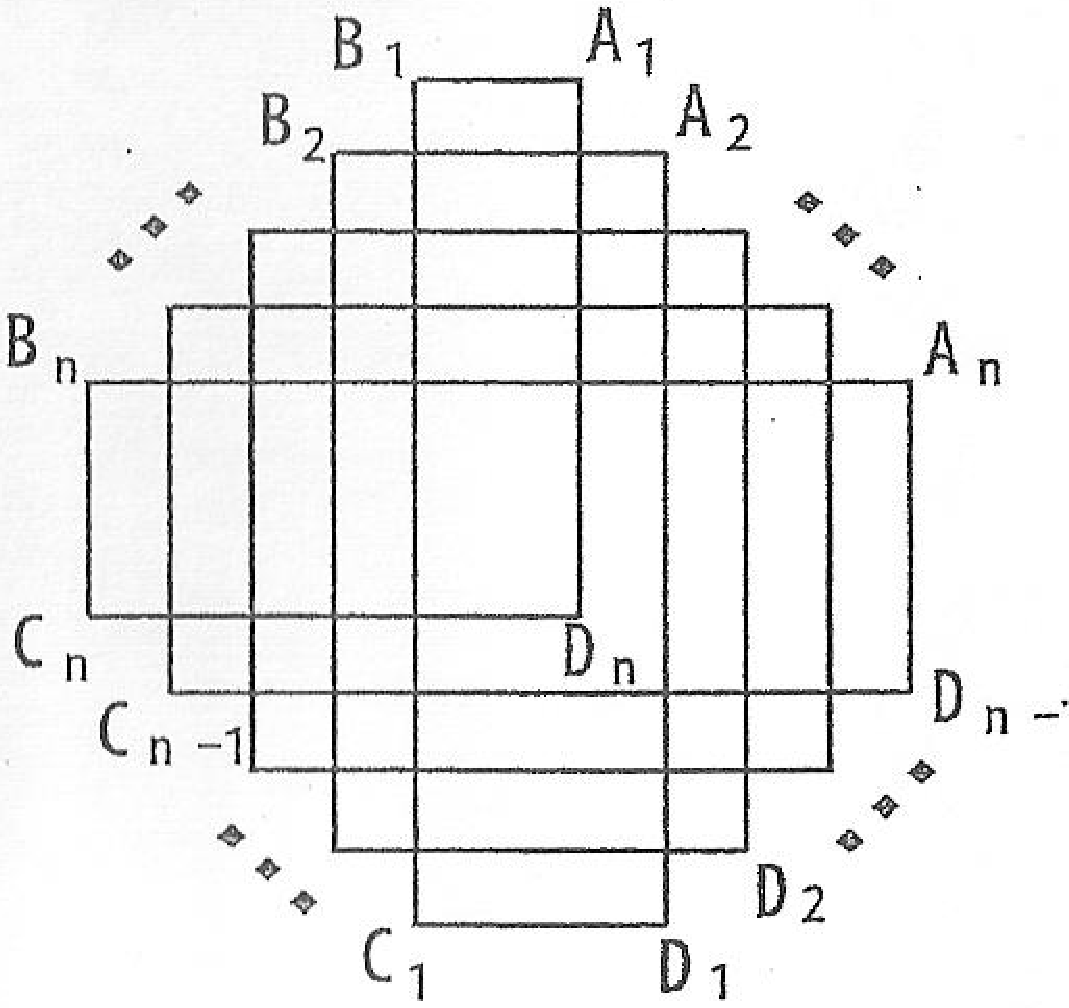
On the other hand, as indicated in the diagram below, if we start by placing in turn with at a left-top position and going down-right direction, and placing in turn with at a left-top position and going down-right direction, and finally placing and by following the rule specified in the problem, we can arrive at a situation where the number of relevant intersection points is exactly . Therefore, the answer we seek for the problem is .
Want a route through all this instead of an archive? The track
puts 2,604 problems in a working order, from Junior Challenge level to the IMO shortlist.