Let be an acute-angled triangle and let , be two points. The diagonals of the quadrilateral meet at the point . Denote by and the orthocenters of the triangles and respectively. The circumcircles of the triangles and meet again at the point () and the circumcircles of the triangles and meet again at the point ().
Show that if the line passes through the point , then it also passes through the point .
DANUBE Mathematical Competition
Solution
Let , be altitudes in the triangle and let , be altitudes in the triangle .
We have and , and thus . We prove that the line passes through the point if and only if the above triangles are congruent.
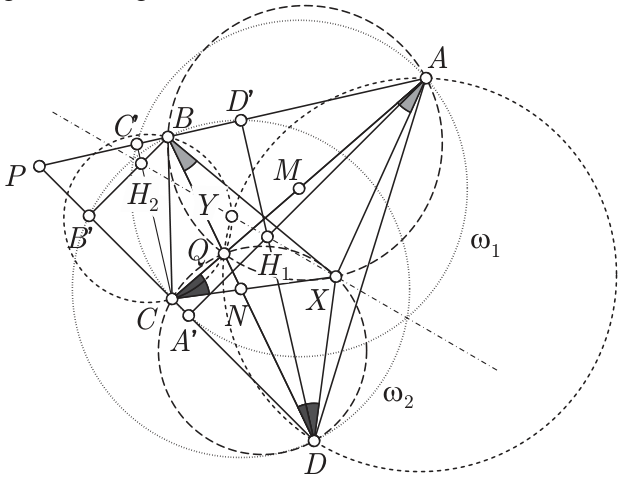
We consider the circles of diameter and respectively. The points belong to the radical axis of these two circles, because
şi ; and similar for . Thus, if and only if .
We have and , were are the centers of the circles and respectively. We notice that is the square of the similarity ratio of the triangles and , or . In the former case, the triangles and should be similar and right angles in . But now the line corresponds to the line by a similarity of center and angle , so – contradiction. Thus is the square of the similarity ratio of the triangles and .
We obtain that if and only if the similarity ratio of the triangles and is 1, that is . But this is equivalent to .
In the same manner, if and only if , and we get the conclusion of the problem.
Want a route through all this instead of an archive? The track
puts 2,604 problems in a working order, from Junior Challenge level to the IMO shortlist.