Olympiad Maths Prep

Library / /14 of 22

Geometry Difficulty 5.7 AIME, harder Prove it Ukraine

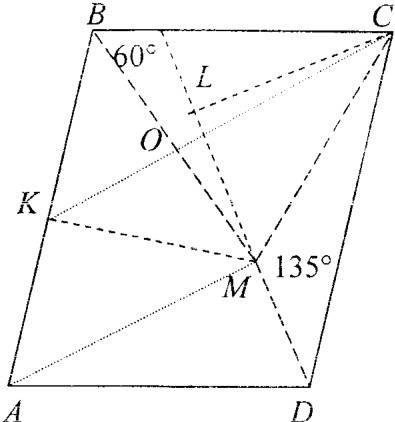
In a parallelogram ABCDABCD ABC=105\angle ABC = 105^\circ. It is known that inside this parallelogram there is a point MM, such that the triangle BMCBMC is equilateral and CMD=135\angle CMD = 135^\circ. Let KK be a midpoint of the side ABAB. Find BKC\angle BKC.

Figure 1

Solution

Drop the perpendicular CLCL to the line DMDM. Then in the triangle MCLMCL we know: MLC=90\angle MLC = 90^\circ, LMC=45\angle LMC = 45^\circ. Therefore, LCM=45\angle LCM = 45^\circ and CL=12CMCL = \frac{1}{\sqrt{2}} CM (fig. 36).

Since LCD=60\angle LCD = 60^\circ, from the right triangle LCDLCD we find that CD=2CL=2CMCD = 2CL = \sqrt{2} CM. So, AB=CD=2CM=2BMAB = CD = \sqrt{2} CM = \sqrt{2} BM, and since ABM=45\angle ABM = 45^\circ, we obtain that BMA=90\angle BMA = 90^\circ.

Then MKMK is a median from the vertex of the right angle in the right triangle AMBAMB, and so KM=BK=AKKM = BK = AK. Therefore, the quadrilateral KBCMKBCM is a deltoid, its diagonals are perpendicular and intersect at the point OO.

Thus in the triangle BOKBOK we have that BOK=90\angle BOK = 90^\circ and OBK=ABCMBC=10560=45\angle OBK = \angle ABC - \angle MBC = 105^\circ - 60^\circ = 45^\circ. This implies that BKO=45\angle BKO = 45^\circ.

Looking for a route rather than an archive? The track puts 2,000 problems in a working order, from AMC 10 level to the IMO shortlist.

Source: MathNet, licensed CC-BY-4.0. Statement and solution reproduced as published; topic and difficulty added by this site.