Let us prove that AK is the bisector of ∠BAM. Point P is equidistant from the lines BC and AC, and also from the lines BM and BC, since ∠ABM=∠MBC=∠CBP=60∘ (fig. 13). Thus P is equidistant from the lines BM and MC, which means that P belongs to the bisector of ∠BMC. Therefore K is equidistant from the lines AC and BM, and also from BM and AP, which proves that AK is the bisector of ∠BAC.
Denote ∠BAK=∠KAC=α. Then step by step we can calculate the following:
∠KMC∠BCA∠BCP∠ACP∠MPC∠AKM=21∠BMC=21(60∘+2α)=30∘+α.=60∘−2α.=21(180∘−60∘+2α)=60∘+α,=60∘−2α+60∘+α=120∘−α.=180∘−(120∘−α+30∘+α)=30∘;=180∘−∠AMK−α==∠KMC−α=30∘+α−α=30∘=∠MPC, what was to be proved.
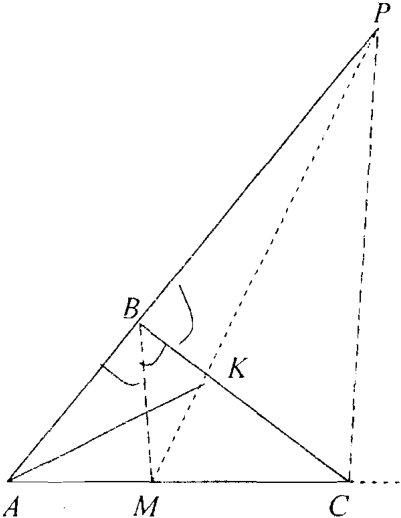
Fig. 13