Maths Olympiad Prep

Library / /12 of 42

Geometry Difficulty 5.4 AIME, harder Prove it Ireland

Consider ABC\triangle ABC with A>90\angle A > 90^\circ and two points DD and EE on segment BCBC so that BAD=CAE\angle BAD = \angle CAE. If the circumcircles of BAD\triangle BAD and CAE\triangle CAE are tangent to each other prove that BAE=CAD=90\angle BAE = \angle CAD = 90^\circ.

Solutions — 2

Solution 1

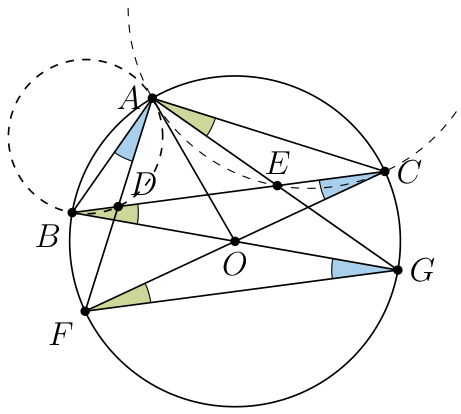
Extend ADAD and AEAE to meet the circumcircle of ABC\triangle ABC at FF and GG, respectively. Let OO be the intersection point of BGBG and CFCF.

Figure 1

Since BAD=CAE\angle BAD = \angle CAE, we have
BCO=OGF=BAD=CAE=CBO=OFG, \angle BCO = \angle OGF = \angle BAD = \angle CAE = \angle CBO = \angle OFG,
subtending equal arcs. Hence OBOB and OCOC are tangents to the circumcircles of BAD\triangle BAD and CAE\triangle CAE by the Alternate Segment Theorem, and OBC\triangle OBC is isosceles with OB=OC|OB| = |OC|. Then OO must be on the common tangent to the circumcircles of BAD\triangle BAD and CAE\triangle CAE, since it has the same power with respect to them. Since OAOA is tangent to the two circles, OA=OB=OC|OA| = |OB| = |OC| hence OO is the circumcentre of ABC\triangle ABC, hence BGBG and CFCF are diameters, thus BAE=CAD=90\angle BAE = \angle CAD = 90^\circ.

Solution 2

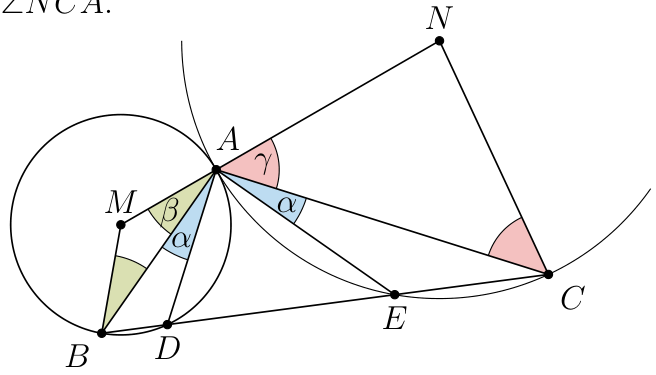
Let M,NM, N be the centres of the circumcircles of triangles BADBAD and CAECAE, respectively. These two circles are tangent at AA iff M,A,NM, A, N are collinear. We define α=BAD=CAE\alpha = \angle BAD = \angle CAE, β=MAB=MBA\beta = \angle MAB = \angle MBA, and γ=NAC=NCA\gamma = \angle NAC = \angle NCA.

Figure 2

We then have BMA=1802β\angle BMA = 180^\circ - 2\beta and ANC=1802γ\angle ANC = 180^\circ - 2\gamma. If MM and DD are on opposite sides of ABAB, we have BDA=18012BMA=90+β\angle BDA = 180^\circ - \frac{1}{2}\angle BMA = 90^\circ + \beta and ADE=180BDA=90β\angle ADE = 180^\circ - \angle BDA = 90^\circ - \beta. Similarly, AED=90γ\angle AED = 90^\circ - \gamma. We now obtain
DAE=180ADEAED=β+γ. \angle DAE = 180^\circ - \angle ADE - \angle AED = \beta + \gamma.
Because M,A,NM, A, N are collinear, this implies 2α+2β+2γ=1802\alpha + 2\beta + 2\gamma = 180^\circ, hence α+β+γ=90\alpha + \beta + \gamma = 90^\circ. Finally, BAE=BAD+DAE=α+β+γ=90\angle BAE = \angle BAD + \angle DAE = \alpha + \beta + \gamma = 90^\circ and DAC=DAE+EAC=β+γ+α=90\angle DAC = \angle DAE + \angle EAC = \beta + \gamma + \alpha = 90^\circ.

If MM and DD were on the same side of ABAB, the above argument, with β\beta replaced by β-\beta in the formulas for BDA\angle BDA, ADE\angle ADE etc., gives the same result. We then see that BDA=90+α>90\angle BDA = 90^\circ + \alpha > 90^\circ, which implies that MM and DD must actually be on opposite sides of ABAB.

Want a route through all this instead of an archive? The track puts 2,000 problems in a working order, from AMC 10 level to the IMO shortlist.

Source: MathNet, licensed CC-BY-4.0. Statement and solution reproduced as published; topic and difficulty added by this site.