(1) Denote by Q, R the midpoints of OB, OC, respectively. It is easy to see that
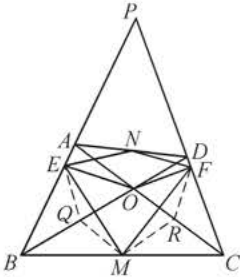
EQ=21OB=RM,MQ=21OC=RF, and
∠EQM=∠EQO+∠OQM=2∠EBO+∠OQM,
∠MRF=∠FRO+∠ORM=2∠FCO+∠ORM.
Because A, B, C, D are concyclic, and Q, R are the midpoints of OB, OC, we have
∠EBO=∠FCO,∠OQM=∠ORM.
So ∠EQM=∠MRF, which implies that △EQM≅△MRF, and EN=FN.
Similarly, we have EN=FN, so EM×FN=EN×FM holds.
(2) Suppose that OA=2a, OB=2b, OC=2c, OD=2d and
∠OAB=α,∠OBA=β,∠ODC=γ,∠OCD=θ.
Then
cos∠EQM=cos(∠EQO+∠OQM)=cos(2β+∠AOB)=−cos(α−β).
So
EM2=EQ2+QM2−2EQ×QM×cos∠EQM=b2+c2+2bccos(α−β).
Making similar equations for EN, FN, FM, we have
⇔⇔⇔EN×FM=EM×FNEN2×FM2=EM2×FN2(a2+d2+2adcos(α−β))×(b2+c2+2bccos(γ−θ))=(a2+d2+2adcos(γ−θ))×(b2+c2+2bccos(α−β))(cos(γ−θ)−cos(α−β))(ab−cd)(ac−bd)=0.
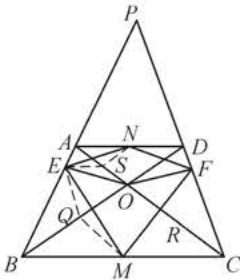
Because α+β=γ+θ, cos(γ−θ)−cos(α−β)=0 holds if and only if α=γ, β=θ (i.e. A, B, C, D are concyclic) or α=θ, β=γ (which follows AB∥CD, a contradiction); ab−cd=0 holds if and only if AD∥BC; ac−bd=0 holds if and only if A, B, C, D are concyclic.
So, when AD∥BC holds, we also have
EM×FN=EN×FM.
We know that A, B, C, D are not concyclic in this case because PB=PC, so the answer is "false".