Let be a convex quadrilateral. A circle passing through the points and and a circle passing through the points and are externally tangent at a point inside the quadrilateral. Suppose that
Prove that .
IMO Shortlist, 2006
Solution
We start with a preliminary observation. Let be a point inside the quadrilateral . Then:
Indeed, if the two circles touch each other then their common tangent at intersects the segment at a point , and so , , by the tangent-chord theorem. Thus .
And conversely, if then one can draw from a ray with on so that , . The first of these equalities implies that is tangent to the circle ; by the second equality, is tangent to the circle , so the two circles are tangent at .
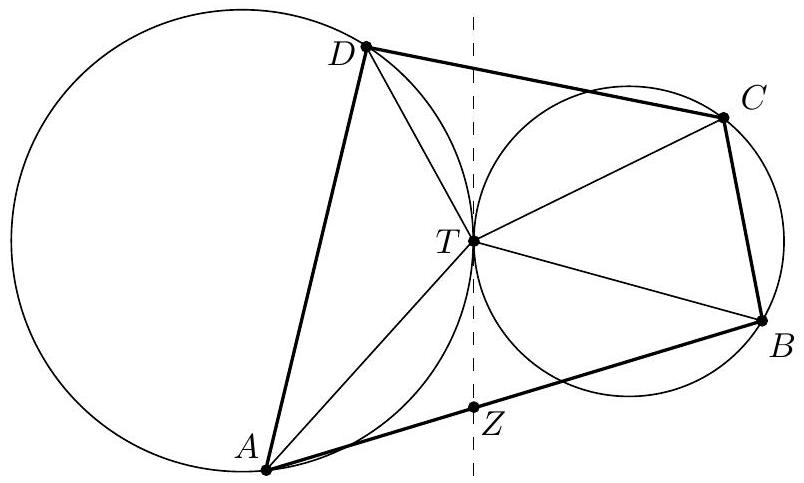
So the equivalence (1) is settled. It will be used later on. Now pass to the actual solution. Its key idea is to introduce the circumcircles of triangles and and to consider their second intersection (assume for the moment that they indeed meet at two distinct points and ).
Since the point lies outside the circle , we have . Therefore the point lies outside the circle . Analogously, also lies outside that circle. It follows that and lie on the same of the circle .
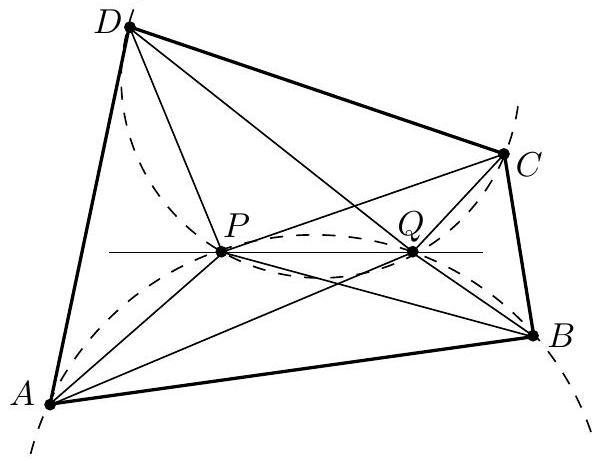
By symmetry, and lie on the same arc of the circle . Thus the point lies either inside the angle or inside the angle . Without loss of generality assume that lies inside the angle . Then
by the condition of the problem.
In the cyclic quadrilaterals and , the angles at vertices and are acute. So their angles at are obtuse. This implies that lies not only inside the angle but in fact inside the triangle , hence also inside the quadrilateral .
Now an argument similar to that used in deriving (2) shows that
Moreover, since , we get
The last sum is equal to , according to the observation (1) applied to . And because , we obtain
Applying now (1) to we conclude that the circles and are externally tangent at . (We have assumed ; but if then the last conclusion holds trivially.)
Finally consider the halfdiscs with diameters and constructed inwardly to the quadrilateral . They have centres at and , the midpoints of and respectively. In view of (2) and (3), these two halfdiscs lie entirely inside the circles and ; and since these circles are tangent, the two halfdiscs cannot overlap. Hence .
On the other hand, since , we have . Thus indeed , as claimed.
Want a route through all this instead of an archive? The track
puts 2,604 problems in a working order, from Junior Challenge level to the IMO shortlist.