Olympiad Maths Prep

Library / /11 of 21

, 2007

Geometry Difficulty 8.4 Shortlist Prove it IMO

Let ABCABC be a fixed triangle, and let A1,B1,C1A_{1}, B_{1}, C_{1} be the midpoints of sides BC,CA,ABBC, CA, AB, respectively. Let PP be a variable point on the circumcircle. Let lines PA1,PB1,PC1PA_{1}, PB_{1}, PC_{1} meet the circumcircle again at A,B,CA', B', C' respectively. Assume that the points A,B,C,A,B,CA, B, C, A', B', C' are distinct, and lines AA,BB,CCAA', BB', CC' form a triangle. Prove that the area of this triangle does not depend on PP.

Solutions — 2

Solution 1

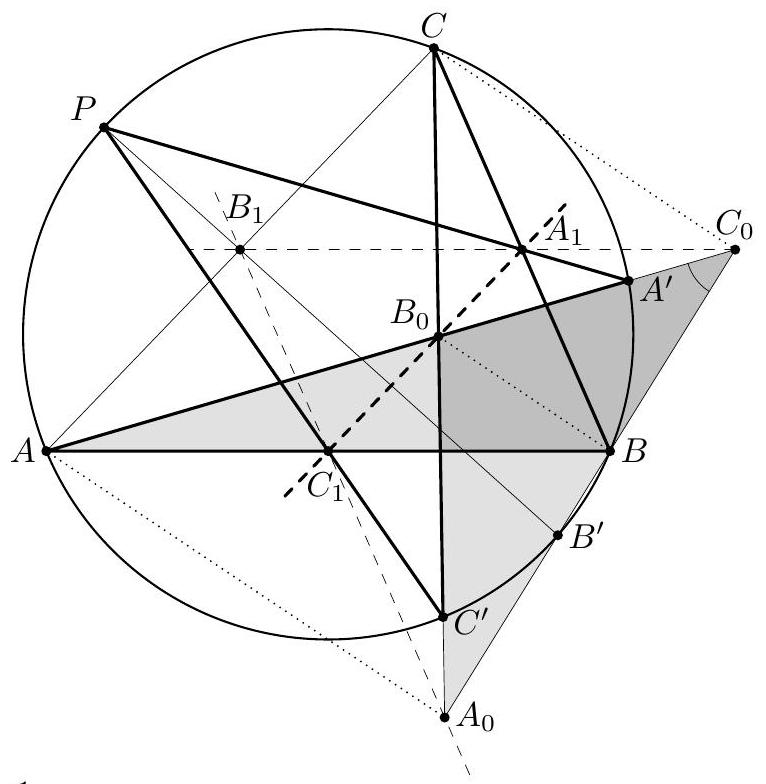
Let A0,B0,C0A_{0}, B_{0}, C_{0} be the points of intersection of the lines AA,BBAA', BB' and CCCC' (see Figure). We claim that area (A0B0C0)=12area(ABC)\left(A_{0}B_{0}C_{0}\right)=\frac{1}{2} \operatorname{area}(ABC), hence it is constant.

Consider the inscribed hexagon ABCCPAABCC'PA'. By Pascal's theorem, the points of intersection of its opposite sides (or of their extensions) are collinear. These points are ABCP=C1AB \cap C'P = C_{1}, BCPA=A1BC \cap PA' = A_{1}, CCAA=B0CC' \cap A'A = B_{0}. So point B0B_{0} lies on the midline A1C1A_{1}C_{1} of triangle ABCABC. Analogously, points A0A_{0} and C0C_{0} lie on lines B1C1B_{1}C_{1} and A1B1A_{1}B_{1}, respectively.

Lines ACAC and A1C1A_{1}C_{1} are parallel, so triangles B0C0A1B_{0}C_{0}A_{1} and AC0B1AC_{0}B_{1} are similar; hence we have
B0C0AC0=A1C0B1C0. \frac{B_{0}C_{0}}{AC_{0}} = \frac{A_{1}C_{0}}{B_{1}C_{0}}.
Analogously, from BCB1C1BC \parallel B_{1}C_{1} we obtain
A1C0B1C0=BC0A0C0. \frac{A_{1}C_{0}}{B_{1}C_{0}} = \frac{BC_{0}}{A_{0}C_{0}}.
Combining these equalities, we get
B0C0AC0=BC0A0C0, \frac{B_{0}C_{0}}{AC_{0}} = \frac{BC_{0}}{A_{0}C_{0}},
or
A0C0B0C0=AC0BC0. A_{0}C_{0} \cdot B_{0}C_{0} = AC_{0} \cdot BC_{0}.
Hence we have
Figure 1
area(A0B0C0)=12A0C0B0C0sinA0C0B0=12AC0BC0sinAC0B=area(ABC0). \operatorname{area}\left(A_{0}B_{0}C_{0}\right) = \frac{1}{2} A_{0}C_{0} \cdot B_{0}C_{0} \sin \angle A_{0}C_{0}B_{0} = \frac{1}{2} AC_{0} \cdot BC_{0} \sin \angle AC_{0}B = \operatorname{area}\left(ABC_{0}\right).
Since C0C_{0} lies on the midline, we have d(C0,AB)=12d(C,AB)d\left(C_{0}, AB\right) = \frac{1}{2} d(C, AB) (we denote by d(X,YZ)d(X, YZ) the distance between point XX and line YZYZ). Then we obtain
area(A0B0C0)=area(ABC0)=12ABd(C0,AB)=14ABd(C,AB)=12area(ABC). \operatorname{area}\left(A_{0}B_{0}C_{0}\right) = \operatorname{area}\left(ABC_{0}\right) = \frac{1}{2} AB \cdot d\left(C_{0}, AB\right) = \frac{1}{4} AB \cdot d(C, AB) = \frac{1}{2} \operatorname{area}(ABC).

Solution 2

Again, we prove that area (A0B0C0)=12area(ABC)\left(A_{0}B_{0}C_{0}\right) = \frac{1}{2} \operatorname{area}(ABC).

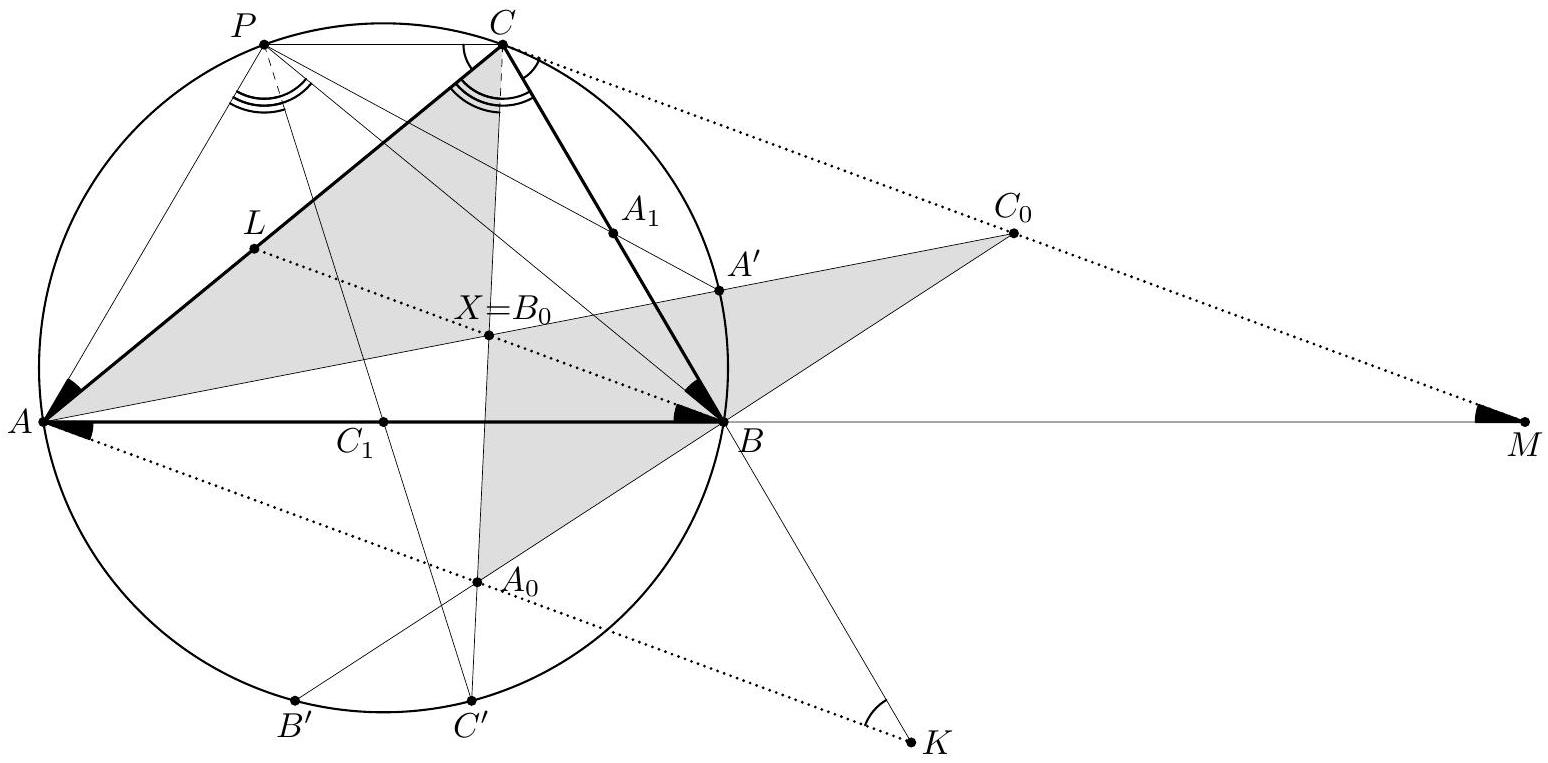
We can assume that PP lies on arc ACAC. Mark a point LL on side ACAC such that CBL=PBA\angle CBL = \angle PBA; then LBA=CBACBL=CBAPBA=CBP\angle LBA = \angle CBA - \angle CBL = \angle CBA - \angle PBA = \angle CBP. Note also that BAL=BAC=BPC\angle BAL = \angle BAC = \angle BPC and LCB=APB\angle LCB = \angle APB. Hence, triangles BALBAL and BPCBPC are similar, and so are triangles LCBLCB and APBAPB.

Analogously, mark points KK and MM respectively on the extensions of sides CBCB and ABAB beyond point BB, such that KAB=CAP\angle KAB = \angle CAP and BCM=PCA\angle BCM = \angle PCA. For analogous reasons, KAC=BAP\angle KAC = \angle BAP and ACM=PCB\angle ACM = \angle PCB. Hence ABKAPCMBC\triangle ABK \sim \triangle APC \sim \triangle MBC, ACKAPB\triangle ACK \sim \triangle APB, and MACBPC\triangle MAC \sim \triangle BPC. From these similarities, we have CMB=KAB=CAP\angle CMB = \angle KAB = \angle CAP, while we have seen that CAP=CBP=LBA\angle CAP = \angle CBP = \angle LBA. Hence, AKBLCMAK \parallel BL \parallel CM.

Figure 2

Let line CCCC' intersect BLBL at point XX. Note that LCX=ACC=APC=APC1\angle LCX = \angle ACC' = \angle APC' = \angle APC_{1}, and PC1PC_{1} is a median in triangle APBAPB. Since triangles APBAPB and LCBLCB are similar, CXCX is a median in triangle LCBLCB, and XX is a midpoint of BLBL. For the same reason, AAAA' passes through this midpoint, so X=B0X = B_{0}. Analogously, A0A_{0} and C0C_{0} are the midpoints of AKAK and CMCM.

Now, from AA0CC0AA_{0} \parallel CC_{0}, we have
area(A0B0C0)=area(AC0A0)area(AB0A0)=area(ACA0)area(AB0A0)=area(ACB0). \operatorname{area}\left(A_{0}B_{0}C_{0}\right) = \operatorname{area}\left(AC_{0}A_{0}\right) - \operatorname{area}\left(AB_{0}A_{0}\right) = \operatorname{area}\left(ACA_{0}\right) - \operatorname{area}\left(AB_{0}A_{0}\right) = \operatorname{area}\left(ACB_{0}\right).
Finally,
area(A0B0C0)=area(ACB0)=12B0LACsinALB0=14BLACsinALB=12area(ABC). \operatorname{area}\left(A_{0}B_{0}C_{0}\right) = \operatorname{area}\left(ACB_{0}\right) = \frac{1}{2} B_{0}L \cdot AC \sin ALB_{0} = \frac{1}{4} BL \cdot AC \sin ALB = \frac{1}{2} \operatorname{area}(ABC).

Looking for a route rather than an archive? The track puts 2,000 problems in a working order, from AMC 10 level to the IMO shortlist.

Source: MathNet, licensed CC-BY-4.0. Statement and solution reproduced as published; topic and difficulty added by this site.