Find all right-angled triangles with integral lengths of sides in which one can inscribe two congruent circles which satisfy the following conditions:
* Their radius is a prime number.
* The circles touch externally.
* Both of the circles are tangent to the hypotenuse and each of them is tangent to a different leg of a triangle.
, 2024
Solution
We will show that there exists only one such triangle and it has sides of length , , and the two touching circles have radius equal to .
In any right-angled triangle with hypotenuse we denote , , . Clearly, two congruent circles with all tangent conditions from the statement exist. Denote them by and such that is tangent to (and is tangent to ). Moreover, denote the tangent points of these two circles to by and , respectively, as in the picture. Consider the incircle of the triangle and denote the tangent point of with .
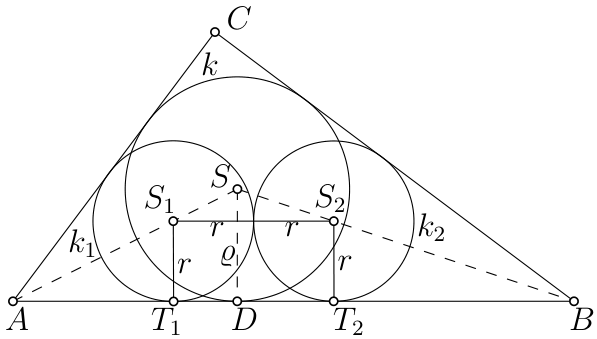
In the first part of the solution we show that the radius of circles and is determined by the equation
In homothety with center and coefficient which maps to , the point is mapped to the point . Therefore, . Analogously, we get the equation . Since is a rectangle, we have . After plugging everything in the equation , by using the relation we obtain
This yields
After using the well-known formula , we obtain the desired formula 1. Suppose that the lengths are integers and put . Then , and . Moreover, the Pythagorean theorem implies that the numbers are pairwise coprime and and have different parity. The number is odd and the number is even. After plugging in , and to 1 we obtain:
We will show that not only the second fraction, but also the first fraction of the right-hand side of 2 is an integer. Suppose that there is a prime that divides both and . Then from the equation we have , which is a contradiction since the numbers and are pairwise coprime. Thus, the number is coprime to and also . Since is an integer, from the equation 2 it follows, that the first fraction is an integer.
By the problem statement, is a prime. By 2 it is a product of three positive integers. Since , we necessarily have and the other two fractions in the right-hand side of 2 are equal to 1. Therefore, we have , and also . It follows that
After dividing by two we obtain
The last equation can be rewritten in the form . It easily follows that , , and . For right-angled triangle with sides and we, indeed, have . This completes the proof.
Want a route through all this instead of an archive? The track
puts 2,000 problems in a working order, from AMC 10 level to the IMO shortlist.